
A slow or completely blocked drain is one of the most common — and most frustrating — plumbing problems Columbus homeowners deal with. Whether it’s a kitchen sink that backs up every few weeks, a shower that pools water around your ankles, or a main line clog that’s affecting every fixture in the house, drain problems have a way of escalating fast.
The good news: most drain clogs are fixable. The challenge is knowing how to fix them the right way — without making things worse or spending money on methods that won’t last. This guide breaks down everything Columbus homeowners need to know about drain cleaning: what causes clogs, which methods actually work, what professional drain cleaning costs in central Ohio, and how to tell when DIY approaches are doing more harm than good.
Why Drains Clog: The Science Behind the Blockage
Before deciding on a solution, it helps to understand what you’re actually dealing with. Drain clogs form differently depending on where they occur and what’s going into your pipes.
Kitchen Drain Clogs
The primary culprits in kitchen drains are fats, oils, and grease (FOG). These substances go down the drain as liquids but solidify as they cool inside your pipes — coating pipe walls and gradually narrowing the passageway. Over time, food particles, coffee grounds, and soap residue bond to the grease buildup, creating a dense, sticky blockage. According to the Water Research Foundation, FOG-related blockages account for nearly 47% of all sewer overflows in the United States annually. Columbus’s older housing stock — much of it built between 1940 and 1980 — is especially susceptible because those original pipes are narrower and have developed mineral scale buildup over decades.
Bathroom Drain Clogs
Bathroom drains clog primarily from hair and soap scum. A single shower drain can collect several grams of hair per use, which mixes with soap residue to form a dense mat that grows over time. Unlike grease blockages, hair clogs tend to build slowly but become nearly impossible to remove with simple plungers once they accumulate. Bathtub drains are worse than shower drains because the lower water velocity allows more buildup before symptoms appear. By the time you notice the water is draining slowly, a significant obstruction has already formed.
Main Line Blockages
When multiple fixtures back up at the same time — toilets, sinks, and tubs all slow down or gurgle simultaneously — you’re likely dealing with a main sewer line blockage. In Columbus and surrounding communities like Westerville, Worthington, and Grove City, tree root intrusion is a leading cause of main line blockages, particularly in homes with large oak or maple trees and older clay or cast iron sewer pipes. Tree roots naturally grow toward water sources — even a hairline crack in an aging sewer pipe sends out moisture vapor that attracts root tips. Once roots enter the pipe, they expand dramatically, eventually causing partial or complete blockage and, in severe cases, structural pipe failure.
DIY Drain Cleaning Methods: What Works and What Doesn’t
Columbus homeowners have plenty of options for tackling drain clogs themselves. Understanding what each method can and can’t accomplish helps you decide when DIY is appropriate and when it’s time to call a professional.
Plungers
A quality plunger — specifically a flange plunger for toilets and a cup plunger for sinks — can clear soft, localized blockages effectively. The hydraulic pressure created by plunging can dislodge clogs that are close to the drain opening and haven’t compacted into the pipe wall. Works well for: Fresh toilet clogs, simple hair clogs near the drain cover, minor soap scum buildup. Won’t work for: Grease blockages deeper in the line, compacted hair mats, tree root intrusion, or any obstruction more than a few feet from the drain opening.
Liquid Drain Cleaners
Products like Drano and Liquid-Plumr use lye (sodium hydroxide) or sulfuric acid to chemically dissolve organic material. They’re convenient and often provide temporary relief — but they come with serious drawbacks. The EPA warns that chemical drain cleaners can damage PVC pipes with repeated use and are highly corrosive to older metal pipes. Research published in Environmental Science & Technology found that repeated use of caustic drain cleaners accelerates pipe corrosion and can degrade pipe joints over time. More critically, these products rarely clear blockages completely — they dissolve enough material to restore flow temporarily, but the clog returns within weeks.
Drain Snakes (Hand Augers)
A drain snake — also called a hand auger — is a flexible cable that you feed into the drain to physically break up or retrieve a clog. Homeowner-grade snakes typically reach 15 to 25 feet and work well for hair clogs, soft blockages, and retrieving physical obstructions. This is genuinely one of the better DIY tools available. For kitchen sink clogs within the first 10–15 feet of drain line, a $30–$50 hand auger from a hardware store in Dublin or Hilliard can be very effective. Limitation: Homeowner snakes don’t reach far enough for main line clogs, and they can’t remove grease coating from pipe walls.
Enzyme Drain Treatments
Bio-enzyme products use live bacteria and enzymes to break down organic material in drains over time. They’re safe for pipes and septic systems, and they work well as maintenance to keep drains clear after a professional cleaning. Works well for: Monthly maintenance, septic system health, odor control. Won’t work for: Active clogs or emergency situations — enzyme treatments take days to weeks to show results.
Professional Drain Cleaning Methods
When DIY methods don’t resolve the issue — or when you’re dealing with recurring clogs, slow drains throughout the house, or suspected main line problems — professional drain cleaning is the right call.
Power Augering (Drain Rodding)
Professional power augers are motorized versions of hand snakes, with cables that extend 50 to 100 feet and rotating heads designed to cut through tough clogs. Where a hand snake punches a hole through a clog, a power auger breaks it apart and retrieves it. This is typically the first tool a plumber reaches for when responding to a clogged drain call in Columbus. It’s effective for most residential drain clogs, is minimally invasive, and can be completed in under an hour for most situations.
Hydro Jetting
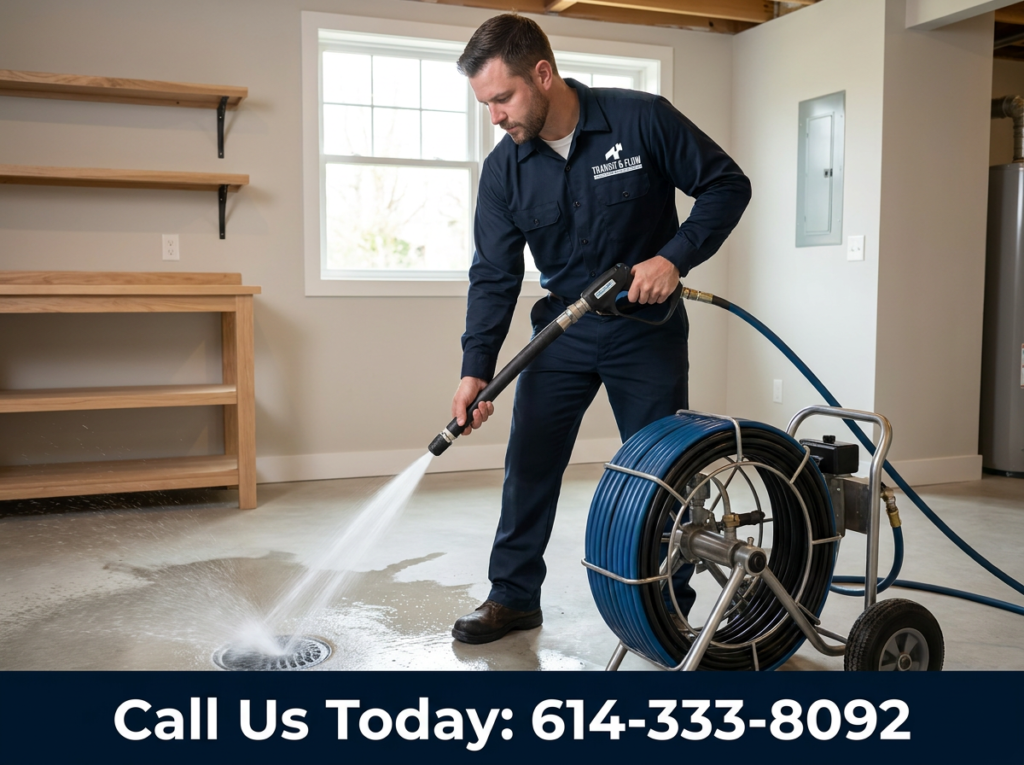
Hydro jetting uses highly pressurized water — typically 3,000 to 4,000 PSI — to blast through blockages and scour pipe walls completely clean. It’s the most thorough drain cleaning method available because it doesn’t just break up the clog; it removes the grease coating, mineral scale, and debris from the entire interior surface of the pipe. The Plumbing-Heating-Cooling Contractors Association (PHCC) recommends hydro jetting for any drain that has experienced recurring blockages, for drains with known FOG buildup, and for any main sewer line prior to lining or repair work. In central Ohio homes — particularly in neighborhoods in Gahanna, New Albany, and Pickerington where homes were built in the 1990s and 2000s with PVC drain lines — hydro jetting is extremely effective. Important: Hydro jetting should only be performed after a sewer camera inspection to confirm the pipe is structurally sound. Any reputable plumber will camera the line before hydro jetting.
Sewer Camera Inspection
A professional sewer camera inspection threads a waterproof camera through your drain lines to provide real-time video of the interior. This is the only way to accurately diagnose the cause and location of a drain problem — whether it’s a grease buildup, tree root intrusion, pipe bellying, or a collapsed section. At Transit & Flow, we use camera inspections to make sure every drain cleaning recommendation is based on what we actually see in the pipe — not guesswork. This means you only pay for the work that actually needs to be done.
Drain Cleaning Costs in Columbus, Ohio (2026)
Here are typical price ranges for professional drain cleaning in central Ohio:
- Standard drain cleaning (kitchen or bathroom sink): $150–$300
- Toilet drain clearing: $125–$250
- Bathtub/shower drain clearing: $150–$275
- Main sewer line cleaning (power augering): $250–$500
- Hydro jetting (residential main line): $350–$750
- Sewer camera inspection: $175–$400
- Camera + hydro jetting combo: $500–$1,000
These figures align with HomeAdvisor’s 2025 national cost data and our experience serving customers throughout Columbus, Dublin, Hilliard, Westerville, Gahanna, Grove City, Pickerington, and Worthington. At Transit & Flow, we provide flat-rate pricing — you know exactly what the work will cost before we start, with no hourly billing and no surprises.
Signs You Need Professional Drain Cleaning Now
Multiple Fixtures Are Affected
When your toilet gurgles while the washing machine drains, or your bathroom sink backs up while the shower is running, you have a main sewer line problem — not individual fixture clogs. This requires professional equipment and won’t respond to any DIY approach.
Water Is Backing Up Into Other Fixtures
If water from the washing machine drains up into a floor drain, or if flushing a toilet causes water to back up into the bathtub, you have a blockage in the main line. This is a genuine plumbing emergency that needs immediate attention to prevent sewage backup into your home.
You Smell Sewage
Sewer gas contains hydrogen sulfide, which is both unpleasant and potentially harmful at high concentrations. If you smell sewage coming from drains or in your basement, something is wrong in the drain system — either a dry trap, a clog allowing gases to escape, or a compromised sewer line. This requires professional diagnosis.
The Clog Keeps Coming Back
If the same drain clogs every 3–6 weeks despite regular clearing, the root cause hasn’t been addressed. Recurring kitchen clogs usually indicate grease accumulation deep in the line that needs hydro jetting. Recurring main line clogs in Columbus homes often indicate tree root intrusion that needs to be cut and treated.
Your Home Is More Than 30 Years Old
Columbus has a significant inventory of homes built in the 1960s through 1980s — many in Clintonville, Bexley, Upper Arlington, and the Short North area — that still have original cast iron or galvanized steel drain lines. These materials corrode and develop scale buildup over time. A camera inspection can tell you the condition of your pipes and what kind of maintenance they actually need.
Ohio Water Quality and Its Impact on Drain Health
Columbus draws its water supply from the Scioto River and Hoover Reservoir, and the area has moderately hard water — typically ranging from 100 to 150 mg/L of dissolved minerals according to Columbus Water Works annual reports. Hard water contributes to mineral scale buildup (primarily calcium carbonate) inside drain pipes and water supply lines over time. This scale acts as a rough surface that grease and debris stick to, accelerating clog formation in older drain lines. Hydro jetting is particularly effective at removing mineral scale along with grease and debris.
Drain Maintenance: Keeping Your Lines Clear Year-Round
- Install mesh drain screens in all showers, bathtubs, and kitchen sinks.
- Never pour grease down the drain. Let it solidify and dispose of it in the trash.
- Run hot water for 30 seconds after each dishwasher cycle to flush residual grease through the line while it’s still liquid.
- Use enzyme drain treatments monthly to break down organic buildup before it accumulates.
- Have your main sewer line camera-inspected every 3–5 years if your home is 20+ years old or you have mature trees in the yard.
- Never flush “flushable” wipes, paper towels, cotton balls, or any non-toilet paper product.
Key Takeaways
- Kitchen clogs are primarily caused by grease; bathroom clogs by hair and soap scum; main line clogs often by tree root intrusion.
- Chemical drain cleaners provide temporary relief but can damage pipes — they don’t solve the underlying problem.
- Hydro jetting is the most thorough drain cleaning method and scours the entire pipe wall clean.
- Columbus’s moderately hard water accelerates mineral scale buildup in older drain lines.
- Multiple fixtures backing up simultaneously = main sewer line problem requiring a professional immediately.
- Recurring clogs are a sign of an underlying problem — not a normal inconvenience to manage with store products.
Professional Drain Cleaning in Columbus — Flat-Rate Pricing, Same-Day Service
Transit & Flow is Columbus’s locally-owned drain cleaning and plumbing specialist. We serve homeowners and light commercial businesses throughout Columbus, Dublin, Hilliard, Westerville, Worthington, Gahanna, Grove City, Pickerington, New Albany, and surrounding communities. Flat-rate pricing you approve before we start. Camera-first diagnostics. Same-day service available. 24/7 emergency response. Family-owned with active owner involvement on every job. Schedule your drain cleaning service with Transit & Flow →
Sources
- Water Research Foundation — Grease-Related Sewer Overflows: Causes and Prevention (waterrf.org)
- U.S. Environmental Protection Agency — Chemical Drain Cleaners and Pipe Safety (epa.gov)
- Plumbing-Heating-Cooling Contractors Association (PHCC) — Hydro Jetting Best Practices (phccweb.org)
- Columbus Water Works — 2025 Annual Water Quality Report (columbuswaterworks.com)
- HomeAdvisor — Drain Cleaning Cost Guide 2025 (homeadvisor.com)
