
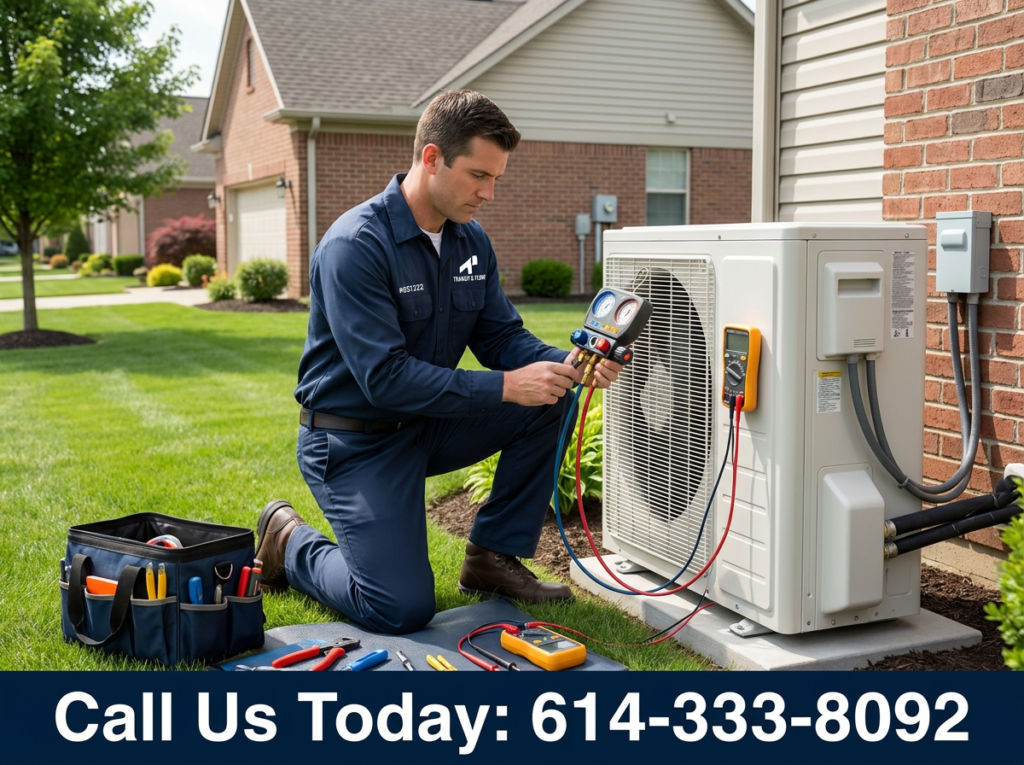
Heating and cooling your Columbus home accounts for roughly 50% of your annual energy bill — and for the tens of thousands of homeowners still running aging furnace-and-AC combos, that number is higher than it needs to be. Heat pumps have quietly become the most cost-effective whole-home comfort system available, and Columbus’s climate — cold winters, humid summers — is now well within the operating range of modern cold-climate heat pumps.
If you’ve been told heat pumps “don’t work in Ohio winters,” that information is outdated. Advances in variable-speed compressor technology have extended reliable heat pump operation down to 0°F and below. This guide breaks down exactly how heat pumps work, what installation costs in Columbus, how to choose the right system, and what you should verify before signing any contract — so you can make a confident, informed decision for your home.
How Heat Pumps Work — and Why Columbus Homeowners Are Switching
A heat pump doesn’t generate heat the way a furnace does. Instead, it moves heat — from outdoor air into your home in winter, and from indoor air to the outside in summer. This refrigeration-cycle approach is dramatically more efficient than combustion heating because you’re transferring energy rather than creating it.
The efficiency metric is called the Coefficient of Performance (COP). A high-efficiency gas furnace converts roughly 95–98% of fuel energy into heat (0.95–0.98 COP). A modern cold-climate heat pump achieves a COP of 2.5–4.0 at moderate temperatures, meaning it delivers 250–400% of the electrical energy input as usable heat. According to the U.S. Department of Energy, air-source heat pumps can reduce electricity use for heating by approximately 50% compared to electric resistance systems, and they outperform gas furnaces on a cost-per-BTU basis at current Columbus-area utility rates.
For Columbus homeowners specifically, AEP Ohio’s residential electric rates and Columbia Gas pricing make heat pumps economically competitive for most households — particularly those replacing equipment that’s 10 or more years old.
Air-Source vs. Ground-Source Heat Pumps
The two main categories are:
- Air-source heat pumps (ASHP): Extract heat from outdoor air. Available as ducted central systems or ductless mini-splits. Most practical for standard Columbus homes. Installation typically requires 1–3 days.
- Ground-source (geothermal) heat pumps: Extract heat from stable ground temperatures (approximately 54°F year-round in Ohio). Higher upfront cost, but highest long-term efficiency. Requires yard space for ground loops. Better suited to larger properties or new construction.
Most homeowners replacing an existing furnace/AC system with a heat pump will install a ducted air-source system. Ductless mini-splits are ideal for home additions, converted garages, or supplemental zones.
What Heat Pump Installation Costs in Columbus, OH
Heat pump costs in the Columbus metro area vary based on system type, SEER2 rating, home size, existing ductwork condition, and whether you’re doing a full replacement or a first-time installation.
| System Type | Typical Installed Cost (Columbus) | Notes |
|---|---|---|
| Ducted air-source heat pump (2–3 ton) | $4,500 – $9,000 | Most common replacement for central AC + furnace |
| Cold-climate ASHP (1–3 ton) | $6,000 – $12,000 | Operates efficiently below 0°F; recommended for Ohio winters |
| Ductless mini-split (single zone) | $2,500 – $5,500 | Per zone; no ductwork required |
| Dual-fuel (heat pump + gas backup) | $7,000 – $14,000 | Heat pump handles shoulder seasons; gas fires on coldest days |
| Geothermal ground-source | $18,000 – $35,000+ | Highest efficiency; qualifies for 30% federal tax credit |
Federal tax credits (2026): The Inflation Reduction Act’s Energy Efficient Home Improvement Credit provides up to 30% (capped at $2,000/year) for qualifying air-source heat pumps. Geothermal systems qualify for the full 30% Residential Clean Energy Credit with no dollar cap. Ohio does not currently offer an additional state-level heat pump rebate, but AEP Ohio occasionally runs equipment upgrade incentive programs — check AEP Ohio’s energy efficiency portal for current availability.
Will My Existing Ductwork Work?
Heat pumps move larger volumes of air at lower temperatures than gas furnaces — which means undersized or leaky ductwork that “worked fine” with your old furnace may cause comfort and efficiency problems with a heat pump. A proper duct assessment (including static pressure testing) should be part of every heat pump installation quote. Duct sealing and resizing, if needed, adds $500–$2,500 to overall project cost but is essential for system performance.
Choosing the Right Heat Pump for an Ohio Winter
This is where many homeowners make an expensive mistake: buying a conventional heat pump rated for mild climates and then discovering it struggles below 20°F. Columbus averages 24 days per year below 20°F and sees occasional stretches below 0°F. Your heat pump must be sized and rated accordingly.
Key Specifications to Verify
- SEER2 rating: The new efficiency standard (replaces SEER as of 2023). Minimum for new installations in the North region is 14.3 SEER2. Look for 17+ SEER2 for meaningful energy savings over a 10–15 year equipment life.
- HSPF2 (Heating Seasonal Performance Factor): Heating efficiency rating. Minimum is 7.5 HSPF2. High-efficiency cold-climate models reach 10+ HSPF2.
- Rated capacity at low ambient temperature: Verify the unit’s rated heating capacity at 5°F and 0°F — not just at 47°F, which is the standard test condition. Cold-climate models (brands like Mitsubishi Hyper-Heat, Bosch, Carrier Greenspeed) maintain 75–80%+ of rated capacity at 0°F.
- Variable-speed compressor: Inverter-driven compressors modulate output continuously rather than cycling on/off. This delivers more consistent temperatures, quieter operation, and 20–30% better efficiency than single-stage units.
Manual J Load Calculation — Non-Negotiable
Per ACCA (Air Conditioning Contractors of America) and ASHRAE 183 standards, every heat pump installation requires a Manual J load calculation — a room-by-room analysis of your home’s heat gain and loss based on insulation levels, window area, orientation, and local climate data. Columbus’s design heating load is based on a -2°F outdoor design temperature (99% heating design condition per ASHRAE). Any contractor quoting a system without performing a Manual J — or using only square footage to size the equipment — is undersizing or oversizing, both of which cause comfort problems and premature equipment failure.
Ready to Schedule Service?
Transit & Flow serves Columbus and surrounding communities with flat-rate pricing you approve before we start.
Heat Pump vs. Furnace + AC: Which Makes More Sense in Columbus?
The honest answer: it depends on your home’s current situation, fuel costs at the time of replacement, and how long you plan to stay in the home. Here’s a practical comparison.
| Factor | Dual-Fuel Heat Pump | Gas Furnace + Central AC |
|---|---|---|
| Upfront cost | $7,000 – $14,000 | $5,500 – $11,000 |
| Annual operating cost (avg. Columbus home) | $900 – $1,400 | $1,100 – $1,800 |
| Federal tax credit available | Up to $2,000 | Up to $600 (furnace only) |
| Equipment lifespan | 15–20 years (heat pump) | 15–20 years (furnace); 12–15 years (AC) |
| Cooling efficiency | 17–22 SEER2 (high efficiency) | 15–22 SEER2 |
| Carbon footprint | Lower (no combustion) | Higher (gas combustion) |
Practical guidance: If your furnace is 15+ years old and your AC is due for replacement anyway, a dual-fuel heat pump system (heat pump handles 80–90% of the year; gas backup kicks in below ~30°F) typically delivers the best comfort and cost balance for Columbus homes with existing gas infrastructure. If you’re building new or have no gas line, a cold-climate heat pump with electric resistance backup is the right choice.
The Installation Process: What to Expect
Understanding what happens during installation helps you ask the right questions, verify the work is done correctly, and avoid surprise add-on charges.
Pre-Installation Assessment
A thorough assessment includes: Manual J load calculation, duct inspection and static pressure test, electrical panel capacity review (most heat pumps require a dedicated 240V circuit), refrigerant line inspection if reusing existing lines, and outdoor unit placement evaluation (adequate airflow clearance, pad leveling, not in a north-facing frost pocket).
Day of Installation
- Removal and EPA-compliant disposal of old equipment
- Outdoor condenser/compressor unit placement and mounting
- Air handler installation or coil replacement in existing air handler
- Refrigerant line set installation (new lines recommended if existing lines are corroded or wrong diameter)
- Electrical connections and disconnect installation
- Thermostat upgrade (most heat pumps require a 2-stage or heat pump-compatible thermostat; smart thermostats like Ecobee and Honeywell T10 are fully compatible)
- System commissioning: refrigerant charge verification, airflow balancing, thermostat calibration, defrost cycle test
Post-Installation Documentation
You should receive: equipment model/serial numbers, installation permit (Franklin County requires permits for HVAC replacements), refrigerant charge documentation, Manual J report, and manufacturer warranty registration confirmation. If any of these are missing, ask before the technician leaves.
Columbus and Franklin County require permits for HVAC equipment replacements. An inspection is required to confirm proper installation. Any contractor who suggests skipping the permit to save time or money is putting you at risk — an uninspected installation can void your equipment warranty and create liability issues if you sell the home.
Suburbs We Serve: Heat Pump Installation Near Me in Columbus
Transit & Flow installs and services heat pump systems throughout the Columbus metro area, within approximately 30 miles of downtown Columbus. Our service area includes Dublin, Westerville, Hilliard, Worthington, Gahanna, Grove City, Pickerington, New Albany, Upper Arlington, Clintonville, Bexley, and Grandview Heights.
Whether you’re searching for a “heat pump installer near me” in Upper Arlington or need a dual-fuel system quote in Pickerington, our team arrives on time, explains every option in plain terms, and provides flat-rate pricing you review and approve before any work begins — no surprises when the job is done.
If you’re in the Columbus area and want an honest assessment of whether a heat pump makes sense for your home, request a free estimate online or call us directly: Call Transit & Flow: 614-333-8092.
The QTF ProCare Annual Maintenance Plan
A heat pump works year-round — unlike a furnace or AC that each operate seasonally. That means it accumulates 12 months of run hours instead of 6, and annual maintenance is especially important to protect your investment and maintain warranty compliance.
Transit & Flow’s QTF ProCare annual maintenance plan covers pre-season HVAC tune-ups (spring and fall), priority scheduling for service calls, and discounted diagnostic fees. For heat pump owners, we include refrigerant pressure checks, coil cleaning, defrost board testing, and airflow measurement at each visit — the same checks a manufacturer’s warranty requires to remain valid. Ask about QTF ProCare pricing when you request your installation estimate.
Frequently Asked Questions: Heat Pump Installation in Columbus, OH
Do heat pumps work in Columbus Ohio winters?
Yes — modern cold-climate heat pumps operate efficiently down to 0°F and below. Columbus averages a 99% heating design temperature of -2°F (ASHRAE), and current variable-speed cold-climate models from manufacturers like Mitsubishi, Bosch, and Carrier maintain 70–80% of rated heating capacity at 0°F. For the handful of nights each year when temperatures fall near or below that range, a backup strip heater or dual-fuel gas furnace provides seamless supplemental heat.
How much does heat pump installation cost in Columbus?
Installed costs in the Columbus metro area typically range from $4,500–$9,000 for a standard ducted air-source heat pump and $6,000–$12,000 for a cold-climate system. Dual-fuel systems (heat pump + gas furnace backup) run $7,000–$14,000. Federal tax credits of up to $2,000 are available for qualifying equipment in 2026. Transit & Flow provides flat-rate pricing you review and approve before work begins — call 614-333-8092 for a specific quote.
Is a heat pump cheaper to run than a gas furnace in Ohio?
At current AEP Ohio electricity rates and Columbia Gas pricing, a high-efficiency cold-climate heat pump typically costs 15–30% less to operate annually than a 96% AFUE gas furnace for whole-home heating in the Columbus area. The exact savings depend on your home’s insulation, the system HSPF2 rating, and utility rate fluctuations. Over a 15-year equipment life, operating savings frequently offset the higher upfront cost of a heat pump vs. a furnace.
How long does heat pump installation take?
A standard heat pump replacement (swapping out an existing split system) takes 6–10 hours for an experienced two-person crew. First-time installations — particularly those requiring new electrical service, duct modifications, or line set replacement — may require two days. Transit & Flow provides a realistic timeline during your pre-installation assessment so you can plan accordingly.
What size heat pump do I need for my Columbus home?
Sizing is determined by a Manual J load calculation — not square footage alone. A 2,000 sq ft Columbus home might need anywhere from 2.5 to 4 tons depending on insulation levels, window quality, ceiling height, and sun exposure. Oversized units short-cycle (turn on and off rapidly), causing poor dehumidification in summer and inconsistent temperatures. Any reputable HVAC contractor will perform a Manual J before recommending equipment size.
Can I replace just the outdoor unit and keep my existing air handler?
Sometimes — but only if the indoor air handler is compatible with the new outdoor unit (matching refrigerant type, coil, and control interface). Mismatched systems void manufacturer warranties and often underperform. In most cases, replacing both indoor and outdoor components simultaneously is more cost-effective and ensures a properly matched, warranted system.
Key Takeaways
- Modern cold-climate heat pumps work in Columbus, OH winters — verified down to 0°F and below.
- Installed costs range from $4,500–$12,000 depending on system type; federal tax credits offset up to $2,000.
- Always require a Manual J load calculation before accepting a system size recommendation.
- Dual-fuel systems (heat pump + gas backup) are the most practical option for Columbus homes with existing gas lines.
- Franklin County requires permits and inspections for HVAC replacements — don’t skip this step.
- Annual maintenance through QTF ProCare protects your warranty and extends equipment life.
Schedule Your Heat Pump Installation Estimate in Columbus
Transit & Flow is a family-owned HVAC and plumbing company based in Columbus, OH, serving homeowners, property managers, HOAs, and small businesses within approximately 30 miles of downtown Columbus. Our certified technicians are fully insured and experienced with heat pump installations, dual-fuel system retrofits, and ductwork modifications throughout the Columbus metro area — including Dublin, Westerville, Hilliard, Worthington, Gahanna, Grove City, and surrounding communities.
Every estimate includes an honest assessment of whether a heat pump is the right choice for your specific home, flat-rate pricing you review and approve before any work begins, and zero pressure to book. We explain your options in plain terms and let you make the call.
- Heat pump installation and replacement
- Dual-fuel system design and installation
- Ductless mini-split installation
- Duct assessment, sealing, and resizing
- Smart thermostat installation and programming
- HVAC maintenance (QTF ProCare annual plan)
- 24/7 emergency service available
Request a free estimate online or call us now: Call Transit & Flow: 614-333-8092. Same-day consultations available.
Not ready to commit? Browse our full service catalog at transitflowplumbing.com to learn about everything we offer — from water heater replacement to drain cleaning to full home repiping.
Sources
- U.S. Department of Energy — Heat Pump Systems: energy.gov/energysaver/heat-pump-systems
- ASHRAE — ASHRAE 183: Peak Cooling and Heating Load Calculations in Buildings Except Low-Rise Residential Buildings
- ACCA — Manual J Residential Load Calculation, 8th Edition: acca.org/standards
- U.S. EPA — ENERGY STAR Certified Heat Pumps: energystar.gov
- Ohio Revised Code § 4740 — Ohio Construction Industry Licensing Board (HVAC contractor requirements and permit requirements)
