
You turn on the shower and wait. The water trickles out at half the pressure it should. You run the dishwasher and notice the kitchen faucet slows to a crawl. Sound familiar? Low water pressure is one of the most common plumbing complaints Columbus homeowners bring to Transit & Flow — and it’s also one of the most misdiagnosed.
Water pressure problems can stem from a single clogged aerator or signal something more significant, like a deteriorating pressure regulator or a slow leak in your main supply line. This guide breaks down the seven most common causes, how to identify which one you’re dealing with, what a professional plumber will do to resolve it, and what repairs typically cost in the Columbus, OH area.
Whether you’re in Dublin, Westerville, Hilliard, Upper Arlington, or anywhere within 30 miles of downtown Columbus, this guide gives you the diagnostic roadmap to move from frustration to a solution.
What Counts as Normal Home Water Pressure?
The EPA and standard plumbing codes define normal residential water pressure as 40 to 80 PSI (pounds per square inch). Columbus Water Works, which serves the City of Columbus and many surrounding communities, targets a delivery pressure between 40 and 80 PSI at the service connection point — but pressure at your fixtures can be noticeably different depending on your home’s internal plumbing.
- Below 40 PSI: Low pressure. Appliances may underperform; showers feel weak.
- 40–60 PSI: Ideal for most homes. Fixtures operate efficiently.
- 60–80 PSI: Acceptable, though on the higher end. A pressure regulator valve (PRV) is recommended.
- Above 80 PSI: High pressure. Increases risk of pipe joint leaks and appliance damage.
How to Measure Your Home’s Water Pressure
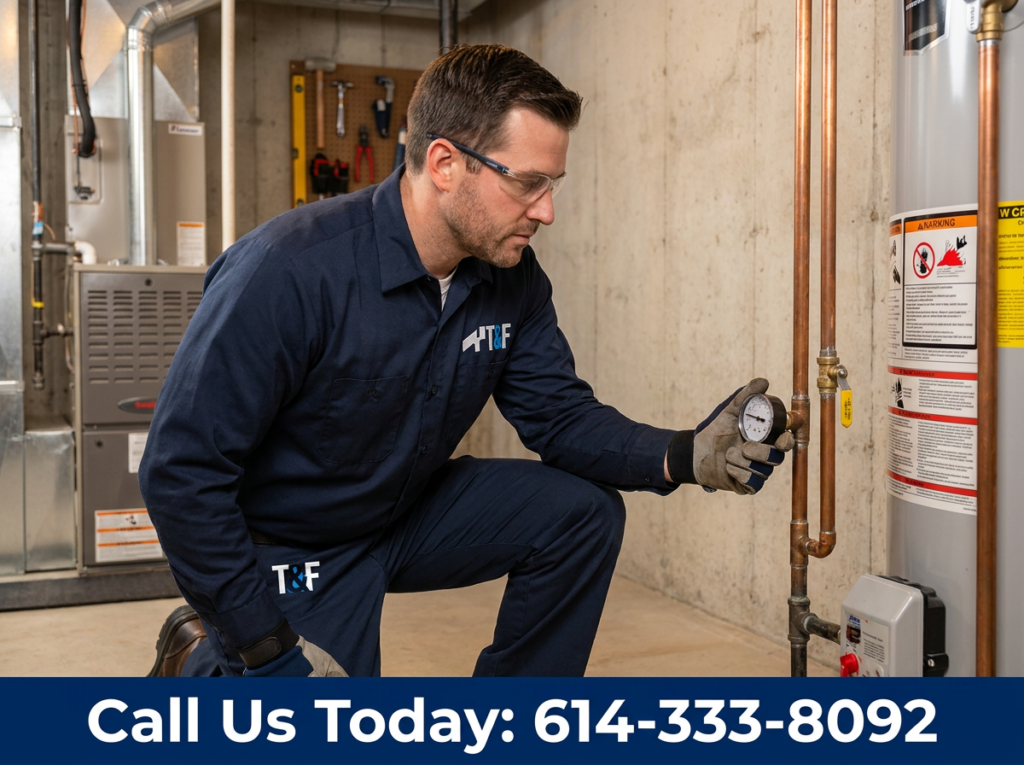
A water pressure gauge costs $10–$20 at any hardware store. Attach it to an outdoor hose bib or laundry room faucet, make sure no water is running elsewhere in the home, and read the PSI. If you consistently see readings below 40 PSI, you have a low pressure problem that warrants investigation. If the gauge reads normal at the meter but low inside — your problem is internal.
7 Most Common Causes of Low Water Pressure in Columbus Homes
Columbus homes range from century-old craftsmen in Clintonville and Bexley with original galvanized steel pipes to new construction in New Albany and Pickerington with modern PEX runs. The cause of low water pressure often depends heavily on the age and material of your plumbing.
1. Partially Closed Main Shutoff Valve
Your home has a main shutoff valve — usually near the water meter, in the basement, or in a utility closet. If this valve was turned during a repair and not fully reopened, it restricts flow to the entire house. This is the first thing any plumber checks, and it’s a simple fix: fully open the valve (turn counterclockwise until it stops). Ball valves should be parallel to the pipe when fully open; gate valves require multiple full turns.
2. Corroded or Clogged Pipes
Galvanized steel pipes — common in Columbus homes built before 1970 — corrode from the inside out. Over decades, iron oxide buildup narrows the interior diameter of the pipe, reducing flow. A pipe that was once 3/4″ ID (inner diameter) can corrode down to less than 1/4″ effective opening. PVC and copper pipes are far less susceptible, but copper can develop mineral scale in areas with hard water. Columbus-area water has moderate hardness (around 120–150 mg/L as CaCO₃ per Columbus Water Works annual reports), which accelerates mineral deposition in older pipes over time.
Signs of pipe corrosion include discolored water (rust or brown tint), pressure that’s dropped progressively over years, and sections of pipe that feel warm to the touch when they shouldn’t. Full home repiping — replacing galvanized runs with PEX or copper — is the long-term solution.
3. Failing Pressure Regulator Valve (PRV)
Most homes built after the 1970s have a pressure regulator valve (PRV) installed near the main shutoff. This bell-shaped device steps down the pressure from the city main (which can run 80–150 PSI) to a safe, appliance-friendly range. PRVs have a lifespan of roughly 7–12 years. When a PRV begins to fail, it can either drop pressure house-wide or allow pressure to creep dangerously high. A plumber can test the PRV with a gauge and replace it in a single service call. Replacement costs in Columbus typically run $250–$500 installed.
4. Pressure Drop on a Shared Supply Line
Older neighborhoods in Grandview Heights, Clintonville, and Short North sometimes have homes connected to aging municipal mains with multiple taps. During peak morning and evening usage hours, pressure can drop noticeably if the area’s main is undersized for current demand. If your pressure is fine at 2 a.m. but weak at 7 a.m., this is likely a contributing factor. A pressure booster pump can compensate for this.
5. Leaking Main Water Line
A slow leak in the underground supply line between the street meter and your home’s foundation will reduce pressure at every fixture. Because this section runs underground, leaks often go undetected for months. Warning signs include unexplained increases in your Columbus Water Works bill, soft or wet spots in the yard, and consistently low pressure that doesn’t respond to valve adjustments. Leak detection and main water line repair or replacement is a job for a professional plumber with camera and pressure-testing equipment.
6. Clogged Aerators and Showerheads
If only one or two fixtures have low pressure while the rest of the house is fine, the problem is local, not systemic. Faucet aerators — the mesh screen at the tip of the spout — collect sediment and mineral deposits over time. Showerheads do the same. Unscrew the aerator, soak it in white vinegar for 30 minutes, and rinse it clear. This costs nothing and takes five minutes. If it doesn’t resolve the issue, the fixture itself may need replacement.
7. Water Pressure Booster Pump Failure
Some homes, particularly multi-story houses in Worthington and Gahanna or properties at elevation, were installed with water pressure booster pumps to compensate for naturally lower incoming pressure. When these pumps fail or wear out, pressure drops house-wide. Booster pump replacement in Columbus runs $400–$900 installed depending on pump size and system complexity.
Ready to Schedule Service?
Transit & Flow serves Columbus and surrounding communities with flat-rate pricing you approve before we start.
How to Diagnose Low Water Pressure Step by Step
Use this checklist before calling a plumber. Some causes are DIY-resolvable in under 10 minutes:
- Check the main shutoff valve. Is it fully open? Ball valve parallel to pipe = open. Gate valve fully counterclockwise = open.
- Attach a pressure gauge to an outdoor hose bib. With no water running, read the PSI. Below 40? You have a confirmed pressure problem.
- Isolate the problem. Is it every fixture or just one? One fixture = local clog (aerator/showerhead). All fixtures = systemic issue (PRV, pipes, main line, or municipal supply).
- Check your water bill. An unexplained spike of 10%+ over 30 days suggests a leak in the supply line.
- Check for wet spots in the yard along the path from street to house. Soggy ground or a noticeably greener strip of grass often indicates a buried leak.
- Clean faucet aerators and showerheads if the problem is fixture-specific. Soak in white vinegar, rinse, reinstall.
- Note the time of day when pressure is lowest. Pressure that drops only during peak morning hours (6–9 a.m.) points to a municipal supply issue rather than an internal one.
If steps 1–7 don’t resolve the problem or identify a clear cause, it’s time to call a plumber. A professional can perform a full pressure test, run a camera through your main line, and check the PRV with calibrated equipment.
What a Plumber Does to Diagnose and Fix Low Water Pressure
When a Transit & Flow plumber arrives at a Columbus home for a water pressure complaint, here’s the diagnostic sequence:
Step 1: Whole-House Pressure Test
Using a calibrated test gauge at the hose bib and at the main shutoff, the plumber establishes baseline incoming pressure and compares it to pressure at various fixtures throughout the home. This tells them whether the issue is upstream (city supply, PRV) or downstream (internal plumbing, fixture-specific).
Step 2: PRV Inspection and Testing
The PRV is tested independently. A failing PRV is one of the most common causes of sudden pressure drops in Columbus homes built between 1975 and 2005. If the PRV is the culprit, replacement is straightforward and solves the problem immediately.
Step 3: Main Line Camera Inspection
If the PRV is functioning correctly, a camera is run through the main supply line to look for corrosion, root intrusion, partial blockages, or signs of a slow leak. A sewer and pipe camera inspection can also reveal corrosion levels inside older galvanized or cast iron runs that pressure testing alone won’t show.
Step 4: Repair or Recommend
Once the cause is identified, Transit & Flow provides a flat-rate quote you review and approve before any work begins. Common repairs include PRV replacement, aerator cleaning, pipe section replacement, booster pump installation, or a recommendation for full home repiping if corrosion is widespread.
Low Water Pressure Repair Costs in Columbus, OH
Here are typical cost ranges for low water pressure repairs in the Columbus metro area, based on standard plumbing labor and material rates:
| Repair Type | Typical Cost Range | Notes |
|---|---|---|
| PRV replacement | $250–$500 | Single service call; usually completed in 1–2 hours |
| Booster pump installation | $400–$900 | Depends on pump size and existing plumbing layout |
| Aerator/showerhead cleaning | DIY: $0–$10 | Can be done by homeowner; vinegar soak method |
| Pipe section replacement | $150–$600 | Varies by pipe material, access, and linear footage |
| Whole-home repiping (PEX) | $4,000–$12,000+ | Depends on home size, pipe runs, and access points |
| Main water line repair | $500–$2,500 | Trenchless options available depending on site conditions |
| Camera inspection | $150–$300 | Often credited toward repair if service is booked |
All Transit & Flow quotes are flat-rate — you see the full price before the work starts. No surprises when the job is done. Request an estimate online or call Transit & Flow: 614-333-8092 to schedule a pressure diagnostic.
Preventing Water Pressure Problems: Annual Maintenance
Most water pressure issues don’t appear overnight. Corrosion, PRV wear, and mineral scale build over years. The most cost-effective way to avoid a sudden pressure problem is a scheduled annual plumbing inspection.
Transit & Flow’s QTF ProCare annual maintenance plan includes a full home plumbing checkup: pressure testing, PRV inspection, water heater flush, drain health check, and a written report of any developing concerns. Members also receive priority scheduling and discounts on service calls. Ask about QTF ProCare when you call or submit your request online.
Beyond annual maintenance, here are habits that protect your plumbing system:
- Clean faucet aerators and showerheads every 6–12 months in hard-water areas
- Know where your main shutoff valve is and confirm it opens/closes smoothly at least once a year
- Check your water bill monthly for unexplained usage spikes (a strong indicator of a slow leak)
- Have your PRV tested if your home is more than 10 years old and you haven’t had it inspected
- If you live in a home built before 1970 in Columbus — Clintonville, Bexley, German Village, Short North — consult a plumber about your pipe material. Galvanized steel has a 50–70 year lifespan.
Frequently Asked Questions: Low Water Pressure in Columbus Homes
Why is my water pressure low only in the morning?
Morning pressure drops that recover by midday typically indicate a municipal supply issue. Columbus-area water mains serve many homes simultaneously, and during peak usage hours (6–9 a.m.), demand can temporarily outpace supply capacity at the nearest main. A pressure booster pump resolves this inside your home if the municipal pressure is consistently low.
Can low water pressure damage my appliances?
Yes. Dishwashers, washing machines, and water heaters are designed to operate at a minimum inlet pressure — typically 20 PSI for most appliances, though some require 40 PSI for normal operation. Sustained low pressure causes incomplete fill cycles, increased run times, and accelerated wear on inlet valves. The U.S. Department of Energy notes that appliances operating outside design pressure ranges consume more energy and fail sooner.
How long does a PRV replacement take?
A straightforward PRV replacement takes 1–2 hours. The water is shut off at the main for the duration of the swap. Most homeowners are back to full pressure within the same service visit. Transit & Flow carries PRVs in multiple sizes on every service vehicle to avoid parts delays.
Does low water pressure mean I have a leak?
Not necessarily — but a leak is one of the causes. If your water pressure dropped suddenly (rather than gradually), and your water bill is higher than usual, a supply line leak is a likely culprit. A plumber can confirm or rule this out with a pressure drop test: they shut off all fixtures, record the pressure reading, and check 15 minutes later. If pressure dropped with nothing running, there’s a leak somewhere in the system.
Can I increase water pressure by adjusting the PRV myself?
PRVs have an adjustment screw on top that allows minor pressure changes (typically 10–15 PSI). Homeowners can attempt this carefully, but over-tightening the adjustment bolt can damage the PRV diaphragm. If the PRV is already failing, adjusting it may accelerate failure. We recommend having a plumber test the PRV first before attempting adjustments — especially if the unit is more than 8 years old.
Is low water pressure covered by homeowner’s insurance?
Homeowner’s insurance covers sudden, accidental damage — not wear and equipment failure over time. PRV replacement, pipe corrosion remediation, and booster pump repair are typically out-of-pocket plumbing expenses. However, if a sudden main line break caused by a covered event (freezing, ground movement) leads to pressure loss, that repair may qualify for a claim. Contact your insurance provider for specifics. Columbus Water Works handles pressure issues on the municipal side (up to your meter); everything from the meter into your home is the homeowner’s responsibility.
Key Takeaways
- Normal water pressure in Columbus homes is 40–80 PSI; below 40 PSI signals a problem.
- The 7 main causes are: partially closed valve, corroded pipes, failing PRV, shared supply pressure drop, main line leak, clogged fixtures, and booster pump failure.
- Clean aerators and check the main shutoff valve first — these are free DIY steps.
- PRV replacement is the most common professional fix, typically $250–$500 installed.
- Homes built before 1970 with galvanized pipes are at highest risk of ongoing pressure issues.
- Annual maintenance through QTF ProCare catches developing problems before they become expensive repairs.
Schedule a Water Pressure Diagnostic in Columbus, OH
Transit & Flow is a family-owned plumbing company serving Columbus and the surrounding communities — including Dublin, Westerville, Hilliard, Worthington, Gahanna, Grove City, Pickerington, New Albany, Upper Arlington, and Grandview Heights — within 30 miles of downtown Columbus.
Our services include:
- Water pressure diagnostics and PRV testing
- Pressure regulator valve replacement
- Whole-home repiping (PEX and copper)
- Main water line repair and replacement
- Pressure booster pump installation
- Drain cleaning and hydro-jetting
- Water heater installation and repair
- Sewer camera inspections
- QTF ProCare annual maintenance plan
All work is priced at a flat rate you review and approve before any work begins. No obligation to book, no surprise charges when the job is done. 24/7 emergency service available.
Call Transit & Flow: 614-333-8092 — Same-day service available for water pressure problems throughout Columbus and central Ohio.
Sources
- Columbus Water Works, Annual Water Quality Report 2024 — water pressure delivery standards and hardness data for Columbus service area.
- U.S. Environmental Protection Agency (EPA), “Protecting Water Quality from Agricultural Runoff” and residential water pressure guidance (EPA 841-F-05-001).
- U.S. Department of Energy, “Water Heating” — appliance performance and pressure requirements for residential water heaters and fixtures (energy.gov).
- Plumbing-Heating-Cooling Contractors Association (PHCC), residential plumbing standards and PRV maintenance recommendations.
- American Society of Plumbing Engineers (ASPE), “Plumbing Engineering Design Handbook” — pipe sizing, pressure ratings, and flow rate standards.
