
A water heater can quietly account for a meaningful share of a home’s energy use, so tank vs tankless efficiency is a fair question when replacement time comes. But the right answer is rarely as simple as “tankless always wins.” Your household’s hot-water habits, the condition of the existing venting and gas line, available electrical capacity, and the installation cost all matter.
For many Columbus-area homeowners, a tankless unit can reduce wasted energy and provide long, steady hot-water delivery. A modern storage-tank water heater may still be the more practical and cost-effective choice for a smaller household, a tight replacement budget, or a home that does not need high simultaneous hot-water output. The goal is to compare the full picture before approving a replacement.
How Tank and Tankless Water Heaters Use Energy
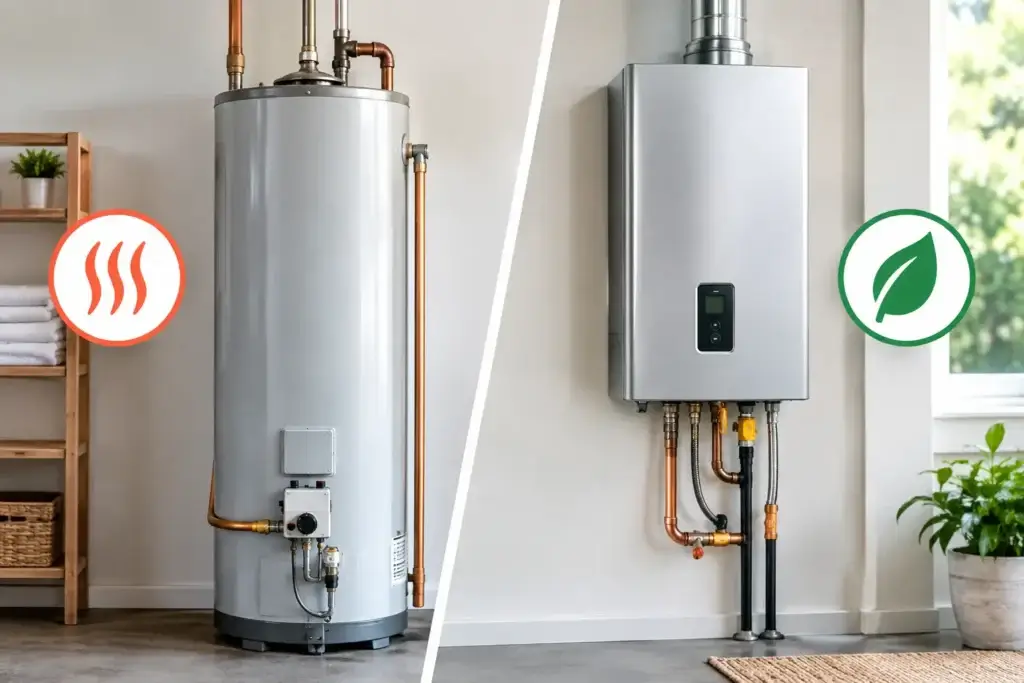
A conventional tank water heater heats a stored supply of water, commonly 40 to 75 gallons. Once the water reaches the set temperature, the unit cycles on as needed to maintain it. That means it uses some energy even when no one is showering, running the dishwasher, or doing laundry. This is called standby heat loss.
A tankless water heater heats water when a fixture calls for it. Cold water moves through the unit’s heat exchanger, and the burner or electric elements activate only while water is flowing. Because it does not keep a large reserve of hot water on standby, it can avoid much of that ongoing energy use.
That operating difference is the core of the efficiency conversation. It does not mean every tankless installation will produce dramatic monthly savings. It means tankless systems have the potential to use less energy when they are properly sized, installed, and used in a household whose demand matches the equipment.
Tank vs Tankless Efficiency by Household Use
Household size and routine have a bigger effect than many people expect. A couple who takes staggered showers and has moderate hot-water use may see a strong efficiency advantage from tankless equipment. The system heats water only when needed, which limits wasted standby energy during quieter parts of the day.
A larger family can also benefit, particularly when several people shower back-to-back. Unlike a tank, a correctly sized tankless water heater does not run out of stored hot water. It can continue heating as long as there is fuel or power and the demand stays within the unit’s capacity.
The key phrase is “within capacity.” If two showers, a dishwasher, and a washing machine all run at once, a tankless unit may not deliver enough hot water for every fixture at the desired temperature. A higher-capacity model or multiple units may be needed. That can increase upfront installation costs and reduce the payback advantage.
A high-efficiency tank water heater can make good sense when demand is predictable and the home already has compatible connections. It offers a familiar setup, lower initial cost in many cases, and enough stored water to handle short periods of heavier use. Once the tank is depleted, though, the household waits for the unit to recover.
The effect of Central Ohio’s cold groundwater
Water entering your home is colder in winter. A tankless system must raise that incoming water to your requested temperature in real time, so its available flow rate can be lower during the coldest months. For example, a unit that performs well for one shower in mild weather may have less capacity when winter groundwater is much colder.
This does not rule out tankless water heating in Columbus. It simply makes accurate sizing essential. A technician should consider the home’s incoming water temperature, the number of bathrooms, fixture flow rates, fuel type, and how often fixtures operate at the same time.
Efficiency Ratings Matter, but They Are Not the Whole Decision
When comparing models, look for the Uniform Energy Factor, or UEF. A higher UEF generally indicates that the water heater converts more of its energy source into delivered hot water. Tankless units often carry higher efficiency ratings than standard tank units, while high-efficiency tank models can also perform very well.
The rating gives you a useful comparison point, but it cannot predict your bill by itself. A household that uses very little hot water may save less with tankless equipment because there is less energy use to reduce. A household with frequent showers and steady demand may have more opportunity to benefit.
Fuel source changes the equation, too. Gas tankless models are popular because they can provide strong heating capacity, but a replacement may require changes to the gas line, venting, condensate drainage, or location. Electric tankless units avoid combustion venting, yet they can require substantial electrical capacity. If the home’s panel and wiring are not equipped for the load, the installation scope can change significantly.
Upfront Cost Versus Long-Term Operating Cost
Tankless water heaters typically cost more to purchase and install than a straightforward tank replacement. The unit itself may be more expensive, and the job can involve venting updates, gas-piping changes, electrical work, or a new drain for condensate on certain high-efficiency models.
Those details are why an estimate should follow an on-site evaluation rather than a quick comparison of equipment prices. A less expensive tankless unit is not necessarily a better value if it is undersized or if required installation work was not included in the initial conversation.
A storage tank is often the lower-cost path when an existing unit has failed and a comparable replacement fits the home’s needs. For homeowners focused on keeping the installation simple, that can be a sensible choice. The trade-off is that a tank will generally have more standby loss and a finite supply of stored hot water.
Long-term value also includes expected service life, maintenance needs, utility costs, and the likelihood of future household changes. If children are moving back home, a new bathroom is planned, or a family is growing, hot-water demand may look different a few years from now.
Maintenance Protects Either System’s Efficiency
No water heater stays at peak performance without care. Sediment can accumulate in a storage tank, especially where water conditions contribute to mineral buildup. That sediment can make the unit work harder and may affect recovery performance over time.
Tankless systems also need maintenance. Mineral scale can build up inside the heat exchanger and restrict performance. Periodic flushing helps protect efficiency and supports reliable operation. The right service interval depends on local water conditions, household use, and the manufacturer’s guidance.
Regular service is also a chance to identify small concerns before they become a no-hot-water emergency. A professional can inspect connections, safety components, venting where applicable, drainage, and overall operation. Clear maintenance records can be helpful when planning future repairs or replacement.
When a Tankless Water Heater Is Usually Worth Considering
Tankless may be a strong fit if your home has consistent hot-water demand, you want longer back-to-back shower capability, and the installation can support the required fuel, venting, or electrical needs without major complications. It can also appeal to homeowners who value a smaller wall-mounted footprint and plan to stay in the home long enough for operating savings to matter.
A tank model may be the better choice if you need a practical replacement quickly, your usage is modest, or the added infrastructure work for tankless would outweigh the expected savings. High-efficiency tank options can offer a balanced middle ground without redesigning part of the home’s utility setup.
Get a Recommendation Based on Your Home
The best water heater is not the one with the highest advertised rating. It is the one that can meet your household’s actual demand safely and reliably, with installation work and operating costs explained clearly before the job starts.
If you are replacing an aging unit or dealing with inconsistent hot water, Transit & Flow can assess your home’s setup, discuss tank and tankless options in plain language, and provide up-front recommendations for your approval. A thoughtful comparison now can help you avoid a rushed choice when the next shower turns cold.
