
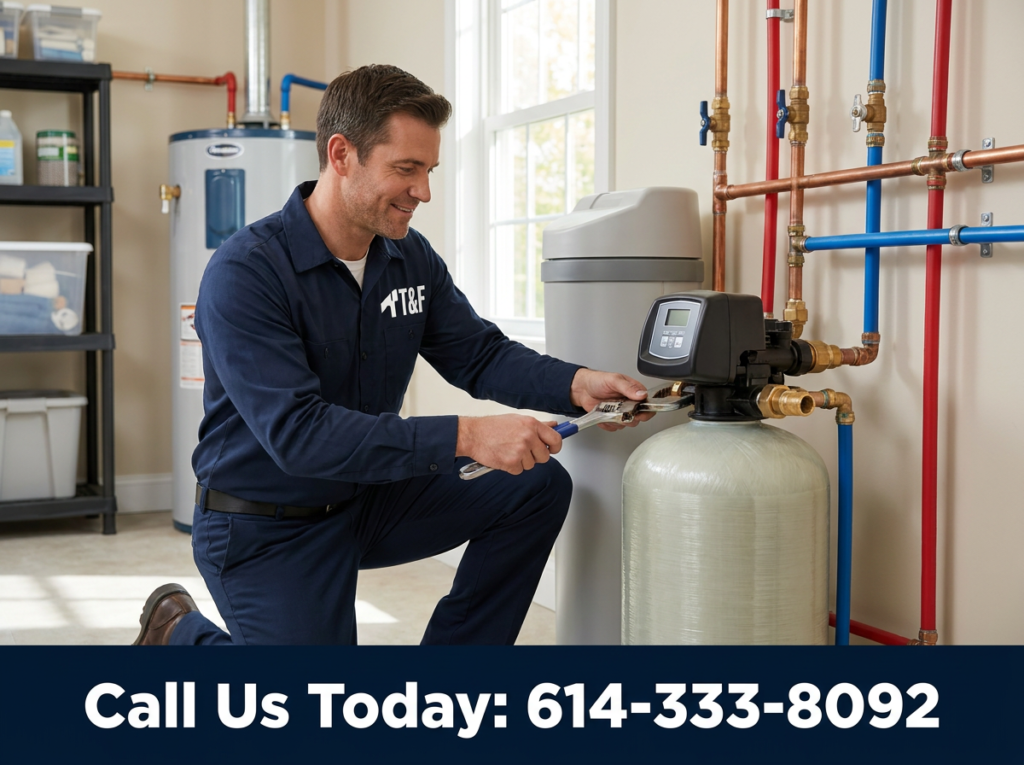
If you’ve noticed white crusty buildup around your faucets, spots on your glasses after washing, or your water heater working harder than it used to — Columbus tap water may be quietly working against your home’s plumbing system. Columbus draws its municipal water from surface reservoirs managed by Columbus Water Works, and while it meets all federal and state safety standards, it carries a mineral load that qualifies as “moderately hard to hard” under U.S. Geological Survey classifications.
Calcium and magnesium concentrations in Columbus tap water typically range from 120 to 150 mg/L — enough to cause noticeable scale buildup over time inside pipes, water heaters, dishwashers, and washing machines. Left unaddressed, that buildup costs homeowners real money in reduced appliance efficiency, premature equipment failure, and higher energy bills.
This guide covers what hard water actually does to your plumbing, the signs your Columbus home is affected, how water softeners work and what they cost, and when a whole-house solution makes financial sense. Whether you’re in Westerville, Gahanna, Hilliard, Upper Arlington, Dublin, or Clintonville, the same hard water challenges apply across the Columbus metro area.
If you’re ready to explore your options now, request an estimate from Transit & Flow — we’ll walk you through your choices in plain terms with flat-rate pricing you review and approve before any work begins.
What Is Hard Water — and How Hard Is Columbus Tap Water?
Water hardness measures the concentration of dissolved calcium and magnesium ions, expressed in milligrams per liter (mg/L) or grains per gallon (GPG). The U.S. Geological Survey uses this classification scale:
| Classification | mg/L (ppm) | Grains Per Gallon (GPG) |
|---|---|---|
| Soft | 0–60 | 0–3.5 |
| Moderately Hard | 61–120 | 3.5–7 |
| Hard | 121–180 | 7–10.5 |
| Very Hard | 180+ | 10.5+ |
Columbus municipal water typically falls in the “hard” range, averaging 120–150 mg/L (roughly 7–9 GPG) depending on the season and which source reservoir — Hoover, O’Shaughnessy, or Griggs — is supplying the system. Columbus Water Works publishes an annual Consumer Confidence Report confirming water quality parameters including hardness.
At 7–9 GPG, you’re in a zone where scale accumulation inside water heater tanks, dishwashers, and pipe fittings accelerates measurably. According to the U.S. Department of Energy, just 1/16 inch of mineral scale on a water heater heating element can reduce efficiency by up to 12%. Over the 8–12-year lifespan of a standard tank water heater, that translates to a meaningful increase in energy costs — on top of shortened equipment life.
What About Well Water in the Columbus Suburbs?
If you’re on a private well in Dublin, Pickerington, New Albany, or a rural township outside Columbus, hardness levels can run significantly higher — sometimes exceeding 250 mg/L. Central Ohio sits over limestone-rich geology, and well water draws directly from those aquifers, concentrating calcium and magnesium well beyond municipal levels. Well water homeowners in the Columbus area are often the first to notice hard water effects, and water softening is almost always recommended.
7 Signs Your Columbus Home Has a Hard Water Problem
Hard water damage accumulates gradually. By the time most homeowners notice it, scale has been building inside pipes and appliances for months or years. Here are the seven most common indicators:
-
White or yellowish scale on faucets, showerheads, and tile grout. Calcium carbonate deposits appear when hard water evaporates, leaving minerals behind. This is the most visible early warning sign and shows up most noticeably in showers and around faucet bases.
-
Spots on glasses and dishes even after the dishwasher runs. Hard water minerals don’t fully rinse away — they leave cloudy deposits on glassware and streaks on dishes that worsen over time.
-
Your water heater is running longer or your energy bill has increased. Scale accumulates on electric heating elements and settles as sediment in gas water heater tanks, reducing heat transfer efficiency. If your 50-gallon water heater is taking noticeably longer to recover, hard water scale is a primary suspect.
-
Reduced water pressure throughout the house. Normal residential water pressure should read 40–80 PSI. Over years, mineral buildup narrows pipe interiors at fittings, elbows, and valves — particularly in older homes with galvanized steel or copper distribution piping. If pressure has dropped gradually without an obvious external cause, scale accumulation inside the plumbing may be restricting flow.
-
Shortened appliance lifespan. The Association of Home Appliance Manufacturers (AHAM) has documented that dishwashers and washing machines operating in hard water areas have significantly shorter service lives than the same units used in soft water — due to scale buildup on spray arms, heating elements, pump seals, and door gaskets.
-
Dry skin and hair after showering. Hard water interferes with soap’s ability to lather and leaves a mineral residue film on skin. Many Columbus residents report noticeably softer skin and hair within weeks of installing a water softener.
-
You’re using more soap and detergent than label recommendations suggest. Hard water minerals bind with soap to form insoluble soap scum rather than lather. If you find yourself adding extra detergent to get dishes or clothes clean, hard water is likely the reason.
How a Water Softener Works — and What Installation Costs in Columbus
Water softeners use a process called ion exchange to remove calcium and magnesium from your home’s water supply before it reaches fixtures, appliances, and hot water systems. Here’s how the process works:
- Hard water enters the softener mineral tank, which contains resin beads carrying sodium (or potassium) ions.
- Calcium and magnesium ions in the incoming water are attracted to the resin beads and swap places with the sodium ions — removing hardness minerals from the water supply.
- Softened water flows out through your home’s distribution system with a trace amount of sodium instead of the hardness minerals.
- On a timed or demand-initiated schedule (typically every 3–7 days), the resin regenerates using a saturated saltwater brine solution that flushes captured minerals down the drain.
- The resin is recharged and the cycle repeats.
The result is water that doesn’t deposit scale, lathers easily with soap, and is gentler on every pipe, valve, appliance, and fixture in your home.
Water Softener Installation Cost in Columbus, Ohio
Installation costs depend on system capacity (measured in grains), water softener type, and the complexity of your specific plumbing rough-in. The following ranges reflect 2025–2026 Columbus market pricing:
| System Type | Equipment | Installation | Total Range |
|---|---|---|---|
| Basic salt-based (24,000–32,000 grain) | $400–$700 | $200–$400 | $600–$1,100 |
| Mid-range salt-based (40,000–48,000 grain) | $700–$1,200 | $250–$450 | $950–$1,650 |
| Whole-house salt-based (60,000+ grain) | $1,200–$2,000 | $300–$500 | $1,500–$2,500 |
| Salt-free conditioner (descaler) | $500–$1,500 | $200–$400 | $700–$1,900 |
| Combination softener + whole-house filter | $800–$2,500 | $300–$600 | $1,100–$3,100 |
A plumbing professional will assess your household size, actual water hardness at your address, pipe material, and available installation space before recommending a system capacity. As a general sizing guide: multiply the number of people in your household by daily gallons per person (approximately 75 gallons), then multiply by your hardness in GPG. For a 4-person Columbus home with 8 GPG hardness: 4 × 75 × 8 = 2,400 grains removed per day. A 32,000-grain softener would regenerate every 13 days — a reasonable cycle.
Ready to Schedule Service?
Transit & Flow serves Columbus and surrounding communities with flat-rate pricing you approve before we start. Same-day service available.
Water Softener vs. Whole-House Water Filter: What Columbus Homeowners Actually Need
This is one of the most common questions we receive during water quality consultations. Here’s the clear answer: a water softener and a whole-house water filter solve different problems.
| What It Addresses | Salt-Based Softener | Whole-House Carbon Filter |
|---|---|---|
| Removes hardness minerals (Ca, Mg) | Yes | No |
| Removes chlorine / chloramine | No | Yes |
| Removes sediment and particulates | No | Yes |
| Reduces iron / manganese | Partially | Yes (iron-specific media) |
| Improves taste and odor | No | Yes |
| Protects pipes, heaters, and appliances | Yes | No |
Columbus Water Works treats the municipal supply with chloramine — a blend of chlorine and ammonia — rather than free chlorine, because chloramine is more stable over the distribution network. While chloramine meets all EPA disinfection standards and is safe at regulated levels, some homeowners prefer to remove it for taste and odor reasons, particularly those with aquariums (chloramine is harmful to fish even at trace levels). A whole-house carbon filter handles that.
If your primary concern is scale buildup on pipes, your water heater, dishwasher, and fixtures — a salt-based water softener addresses that directly and measurably. Many Columbus homeowners in Worthington, Bexley, and Grandview Heights install a combination system: a water softener to remove hardness, followed by a carbon filter stage for taste and chloramine reduction.
What About Salt-Free Conditioners?
Salt-free systems (also called descalers or template-assisted crystallization systems) don’t remove calcium and magnesium — they alter the crystalline structure of those minerals so they’re less likely to adhere to pipe surfaces. They require no salt, no drain connection, and minimal maintenance.
However, independent research including a 2011 Water Quality Research Foundation study found that salt-based ion exchange softeners significantly outperform salt-free conditioners in actual scale prevention at hardness levels above 7 GPG. At Columbus’s typical 7–9 GPG hardness range, a salt-based system delivers more reliable protection for pipes, water heaters, and appliances. Salt-free conditioners may be appropriate where sodium addition is a medical concern or where a drain connection is not feasible.
How Soft Water Protects Your Plumbing System and Appliances Over Time
Water softener installation is a capital expenditure that pays back through extended equipment life, lower energy consumption, and reduced maintenance costs. Here’s what hard water is doing to your home’s systems right now — and what soft water prevents:
Water heaters. This is where hard water causes the most measurable financial damage. Tank-style water heaters in the Columbus area accumulate sediment (mostly calcium carbonate) at the bottom of the tank and scale on electric heating elements. The DOE documents that scale accumulation on heating elements reduces thermal efficiency — a 1/4-inch layer of scale can cut efficiency by up to 40%. A new 50-gallon water heater installation in Columbus typically costs $1,749.99–$2,499.99 fully installed. Soft water has been shown to extend water heater service life by 2–5 years and maintain near-factory efficiency throughout that extended life.
Pipe fittings, valves, and shut-off hardware. Shut-off valves, angle stops under sinks and toilets, mixing valves, and pressure-reducing valves are all susceptible to mineral buildup. A valve seized by scale becomes a genuine problem during a plumbing emergency when you need to shut off the water supply immediately. Soft water keeps valve components moving freely.
PEX and copper piping. Modern PEX piping is less affected by internal scale than galvanized steel, but copper pipe — still common in Columbus homes built between the 1950s and 1990s — experiences accelerated corrosion in the presence of hard water at high temperatures. Copper fittings, solder joints, and elbows are all points where scale tends to concentrate. Drain slope requirements (1/4 inch per foot for horizontal drain runs under the Ohio Plumbing Code) ensure drainage, but scale can gradually narrow supply pipe interiors over years of exposure.
Dishwashers and washing machines. AHAM data indicates that dishwashers operating in hard water accumulate mineral deposits on spray arms, heating elements, and door gaskets that reduce service life by 30–50%. The same pattern holds for washing machines. Given that major kitchen appliance replacement in Columbus runs $600–$1,200 for a dishwasher and $800–$1,500 for a washer, the protective value of soft water adds up quickly.
QTF ProCare Plan note: Transit & Flow’s QTF ProCare annual maintenance plan includes a thorough plumbing inspection — water pressure check, valve function review, water heater condition assessment, and visible pipe inspection. It gives Columbus homeowners early warning when hard water effects are building up before damage becomes expensive.
Professional Water Softener Installation in Columbus, OH: What to Expect
Water softener installation is a multi-step plumbing job that requires cutting into the main supply line, creating a proper drain connection, and connecting a power source — all done in compliance with the Ohio Plumbing Code. Here’s what professional installation involves:
-
On-site water hardness test. A calibrated test confirms your actual GPG hardness at your specific address before sizing the system. Municipal hardness averages can vary by neighborhood depending on distribution system age and reservoir source.
-
Installation point selection. The softener connects to the main cold supply line after the meter and pressure-reducing valve (if present), but before the water heater and distribution branches — so all hot and cold water throughout the home is softened. Outdoor hose bibs are typically left unsoftened via a dedicated bypass, as soft water is unnecessary for irrigation.
-
Bypass valve installation. A properly installed softener always includes a bypass valve assembly so the unit can be isolated for maintenance, salt addition, or regeneration without interrupting water service to the house. This is required for code compliance and is a standard part of every Transit & Flow water softener installation.
-
Drain line connection. The brine regeneration cycle discharges mineral-laden wastewater that must drain properly. Ohio Plumbing Code requires an air gap at the drain connection to prevent backflow contamination. This typically connects to a nearby floor drain or standpipe.
-
Electrical connection. Most modern demand-initiated softeners require a standard 120V outlet within reach of the control valve. If no outlet is available at the installation point, a licensed electrician may need to add one before installation.
-
System programming and calibration. The control valve is programmed with your household size and measured hardness level to set regeneration frequency and salt dosage accurately. A properly calibrated system minimizes salt and water use during regeneration.
Standard professional installation on an accessible supply line with an existing drain and nearby outlet typically takes 2–4 hours. More involved installations requiring new drain plumbing or supply rerouting may take a full day.
If you’re searching for a water softener plumber near me or a Columbus hard water specialist, Transit & Flow serves homeowners and property managers throughout Columbus and surrounding communities — including Dublin, Westerville, Hilliard, Worthington, Gahanna, Grove City, Short North, Pickerington, New Albany, Upper Arlington, Clintonville, Bexley, and Grandview Heights — anywhere within 30 miles of downtown Columbus, OH.
Request your estimate online or call Transit & Flow at 614-333-8092. We’ll give you flat-rate pricing on the right system for your home before any work begins. No obligation to book. 24/7 emergency service available for plumbing issues that can’t wait.
Frequently Asked Questions: Water Softeners in Columbus, Ohio
How do I know if Columbus tap water is hard enough to require a softener?
Columbus municipal water typically measures 7–9 GPG (120–150 mg/L), which falls in the “hard” category under USGS classifications. Visible scale on fixtures, spots on dishes, and declining water heater efficiency are the most common signs. Well water in Dublin, Pickerington, and surrounding townships often runs harder, sometimes exceeding 15 GPG. An on-site hardness test gives you the exact number for your address.
Will a water softener affect my home’s water pressure?
A correctly sized and properly installed water softener should not reduce water pressure. A softener tank adds only a few inches of water column resistance — well within normal operating parameters. In fact, over time, soft water prevents the scale accumulation inside fittings and valves that gradually restricts flow. Normal residential water pressure runs 40–80 PSI. If you’re experiencing low pressure, the cause is likely a pressure-reducing valve, partially closed main shut-off, or scale in older galvanized pipes — not the softener itself.
How much sodium does softened water add, and is that a health concern?
At Columbus’s typical hardness of 8 GPG, a salt-based softener adds approximately 12.5 mg of sodium per 8-ounce glass of water — well below the FDA’s 140 mg per serving threshold for “low sodium” classification. For comparison, a slice of white bread contains roughly 150 mg of sodium. If you’re on a medically supervised sodium-restricted diet, a point-of-use reverse osmosis filter on the kitchen tap provides softened water without added sodium for drinking.
Can a water softener be installed in a home with PEX plumbing?
Yes — PEX piping is fully compatible with softened water, and soft water is actually gentler on PEX compression fittings and push-to-connect connectors. The softener connects to the main supply line upstream of the PEX manifold or distribution runs, so all water throughout the home is conditioned before entering the PEX distribution system.
How long does professional water softener installation take?
For a standard installation — accessible supply line, existing drain connection, nearby electrical outlet — professional installation typically takes 2–4 hours. Situations requiring new drain plumbing, supply line rerouting, or an electrical addition may extend to a full day. Transit & Flow provides a flat-rate quote before starting so you know the full cost upfront.
What is the QTF ProCare plan, and does it cover water softener maintenance?
The QTF ProCare plan is Transit & Flow’s annual plumbing maintenance program for Columbus-area homeowners and property managers. It includes a whole-home plumbing inspection, water heater flush and assessment, water pressure check, and shut-off valve review. While it doesn’t include salt refills (handled by the homeowner), the annual visit includes a check of the softener bypass valve and drain connection to confirm the system is operating correctly. It’s a practical way to stay ahead of issues before they become emergency repairs.
Key Takeaways
- Columbus tap water averages 7–9 GPG (120–150 mg/L) — solidly in the “hard” category that accelerates scale buildup in pipes, water heaters, and appliances.
- A salt-based ion exchange water softener is the most effective solution at Columbus hardness levels.
- Whole-house water softener installation in Columbus typically costs $950–$2,500 depending on system capacity and plumbing configuration.
- Soft water extends water heater life by 2–5 years and maintains near-factory efficiency by preventing scale on heating elements.
- Salt-free conditioners are lower maintenance but significantly less effective at Columbus-level hardness (7–9 GPG).
- Well water in Dublin, Pickerington, and surrounding townships often runs harder than municipal water and frequently benefits most from softening.
- The QTF ProCare annual maintenance plan includes a whole-home plumbing inspection that flags early signs of hard water damage before it becomes costly.
Water Softener Installation in Columbus — From Transit & Flow
Transit & Flow is a fully insured, family-owned plumbing company serving Columbus, OH and communities throughout the metro area. We approach every job the same way: explain your options in plain terms, give you flat-rate pricing you review and approve before any work begins, and leave your home as clean as we found it.
Our water quality services include:
- On-site water hardness testing
- Water softener consultation and sizing
- Whole-house water softener installation
- Salt-free conditioner installation
- Combination softener + filtration systems
- Water heater service and replacement
- Drain cleaning and sewer line inspection
- QTF ProCare annual plumbing maintenance plan
We serve Columbus and all surrounding communities including Dublin, Westerville, Hilliard, Worthington, Gahanna, Grove City, Pickerington, New Albany, Upper Arlington, Clintonville, Bexley, Grandview Heights, and the Short North — anywhere within 30 miles of downtown Columbus, OH.
Call Transit & Flow: 614-333-8092 — Same-day service available.
Or request a free estimate online → No obligation to book.
Ready to Protect Your Columbus Home from Hard Water?
Transit & Flow provides flat-rate water softener installation throughout Columbus and surrounding communities. Get pricing you approve before we start — no surprises.
Sources
- U.S. Geological Survey — Hardness of Water: usgs.gov — Water Hardness Science
- Columbus Water Works — Consumer Confidence Report (Annual Water Quality Report): columbuswater.org
- U.S. Department of Energy — Water Heating Energy Saver: energy.gov — Water Heating
- Water Quality Research Foundation — Softener Performance Study (2011): Referenced via Water Quality Association research database
- U.S. EPA — Secondary Drinking Water Standards: epa.gov — Secondary Standards
