
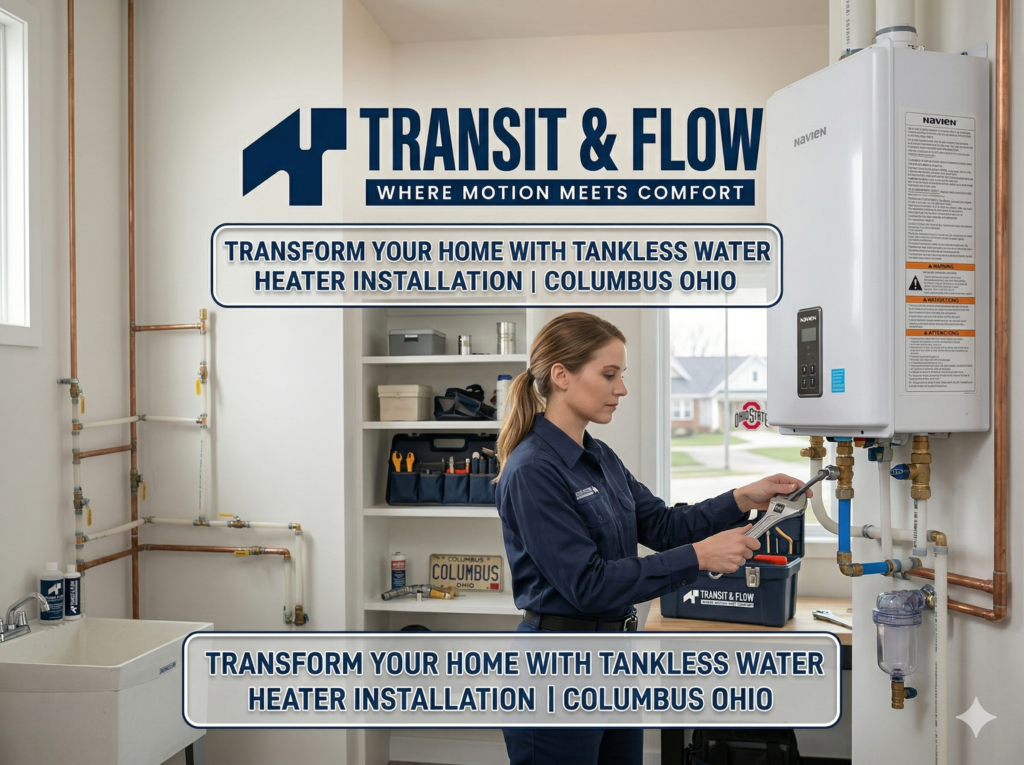
If you’re a Columbus homeowner considering tankless water heater installation, you’re making one of the smartest long-term investments in your home’s infrastructure. This guide covers everything you need to know: real costs in the Columbus market, the best brands, installation timelines, available tax credits, and how to choose the right system for your home or business.
Columbus, Ohio’s housing stock, groundwater temperature, and natural gas infrastructure make it one of the most cost-effective markets in the country for going tankless. Whether you’re replacing a failing 40-gallon tank, building a new home, or upgrading a commercial property, this guide gives you the facts, not sales talk.
What Is a Tankless Water Heater?
A tankless water heater, also called an on-demand or instantaneous water heater, heats water directly as it flows through the unit rather than storing it in a large tank. When you turn on a hot water tap, cold water travels through a pipe into the unit where a gas burner or electric element heats it instantly, delivering hot water within seconds.
Unlike a traditional tank water heater that continuously heats and reheats a 40-to-80-gallon reservoir, a tankless unit only activates when you need it. According to the U.S. Department of Energy, tankless water heaters can be 24 to 34% more energy-efficient than conventional storage tank models for homes that use 41 gallons or less of hot water daily, and 8 to 14% more efficient in high-use households.
Columbus, Ohio’s average groundwater temperature is approximately 52°F year-round. This is a critical factor in tankless sizing because the unit must raise incoming water to 120°F. A properly sized unit accounts for this 68°F rise across your peak simultaneous flow demand.
The key advantages driving strong adoption of tankless systems in Columbus include unlimited hot water on demand, a lifespan nearly double that of tank units (20+ years vs. 8-12 years), space savings from a wall-mounted footprint, and eligibility for federal tax credits through 2032 under the Inflation Reduction Act.
Tankless vs. Tank Water Heater: Side-by-Side Comparison
Before committing to tankless water heater installation in Columbus, Ohio, it helps to understand exactly what you’re comparing. The table below breaks down the key decision factors for most residential and light commercial applications.
| Factor | Tankless | Traditional Tank | Winner |
|---|---|---|---|
| Upfront Cost | $4,299.99 – $6,999.99 installed | $1,749.99 – $2,499.99 installed | Tank |
| Lifespan | 20 – 25 years | 8 – 12 years | Tankless ✓ |
| Energy Efficiency | 24 – 34% more efficient | Baseline | Tankless ✓ |
| Hot Water Supply | Unlimited, on-demand | Limited by tank size | Tankless ✓ |
| Space Required | Wall-mounted, compact | Large floor footprint | Tankless ✓ |
| Annual Operating Cost | Lower (no standby heat loss) | Higher (continuous heating) | Tankless ✓ |
| Installation Complexity | Higher (gas/venting mods often needed) | Simple swap | Tank |
| Federal Tax Credit (2026) | Up to $600 (30% of cost) | None | Tankless ✓ |
| Long-Term Value (20 yrs) | Higher ROI, fewer replacements | Lower ROI, 2-3 replacements | Tankless ✓ |
The ROI math is straightforward for most Columbus homeowners: over a 20-year span, a tankless unit can save $3,000 to $7,000 in energy costs and avoided tank replacements compared to two or three traditional tank units. When combined with the federal tax credit, the break-even point often comes within 4 to 6 years.
Real Costs of Tankless Water Heater Installation in Columbus, Ohio
Pricing transparency is a core value at Transit & Flow. Here’s an honest breakdown of what tankless water heater installation costs in Columbus, Ohio in 2026. Every Transit & Flow job includes flat-rate pricing provided before work begins, with no surprise labor overages.
Pricing covers qualifying standard installations. New electrical circuits, panel upgrades, condensate-routing complications, confined-space modifications and fuel conversions may require additional approved work. Rebates and tax incentives are applied separately and are not deducted from the displayed installation price.
What Affects the Final Installation Price?
- Gas line sizing: Many older Columbus homes have ¾” gas lines that must be upgraded to 1″ or larger to supply the higher BTU demand of a tankless unit. This is the most common hidden cost and averages $300 to $800 in Columbus.
- Venting type: Condensing tankless units use PVC venting (lower cost), while non-condensing models require stainless steel Category III or IV vent pipe, which increases material cost.
- Location of installation: Replacing a basement tank with a wall-mounted unit in the same location is simpler than relocating to a utility closet or garage.
- Permit and inspection fees: Columbus, Ohio requires a plumbing permit for all water heater installations. Permit fees are set by the municipality and are itemized separately from the installation price.
- Water softener requirement: Columbus has moderate to hard water (150-300 mg/L hardness in many areas). A water softener or scale filter is strongly recommended to protect your tankless unit’s heat exchanger and preserve the manufacturer’s warranty.
Be wary of any contractor quoting tankless water heater installation in Columbus under $900 without first inspecting your gas line, venting, and water quality. The unit cost alone for a quality gas tankless heater starts at $600 to $1,200. Underbidding usually means a low-grade unit, unpermitted work, or undisclosed upsells at completion.
7 Signs It’s Time to Replace Your Water Heater in Columbus
Whether you have an aging tank unit or a failing tankless system, these are the definitive signs that replacement is the smarter investment over repair. Our water heater service team diagnoses these situations daily across Columbus.
- Age over 10 years (tank) or 15 years (tankless): Both unit types experience accelerating failure rates as they approach end-of-life. Components become harder to source, and efficiency drops measurably with scale buildup and heat exchanger wear.
- Inconsistent water temperature: Hot water that fluctuates during a shower or goes cold mid-use is a clear sign your unit is struggling, particularly in high-demand households.
- Rusty or discolored hot water: Rust in hot water lines from a tank unit indicates internal corrosion. Once the anode rod is depleted and the tank walls begin corroding, replacement is imminent.
- Rumbling or popping sounds: Sediment accumulation at the bottom of tank units causes these sounds. In Columbus’s moderately hard water environment, this accelerates significantly over time.
- Rising energy bills without explanation: A declining efficiency curve is a reliable indicator of heat exchanger degradation. If your gas bill has crept up with no other obvious cause, your water heater deserves a diagnostic visit.
- Visible corrosion or moisture around the unit: Any pooling, rust staining, or moisture around a tank unit indicates a seal failure or hairline crack. A leaking tank is a water damage emergency, not a “watch and wait” situation.
- Frequent repairs in the last 12 months: The rule is simple: if repair costs exceed 50% of replacement cost, replace. A water heater nearing end-of-life absorbs parts and labor at an accelerating rate.
If you’re experiencing any of these issues, our 24-hour emergency plumbing team can respond same-day across Columbus. We provide a complete diagnostic and a flat-rate replacement quote before any work begins.
Best Tankless Water Heater Brands in 2026
The tankless water heater market has matured significantly. The brands below represent the top-performing units Transit & Flow’s licensed technicians install and service throughout Columbus, ranked on reliability, efficiency, parts availability, and customer satisfaction.
Transit & Flow recommends and installs all of the above brands. During your free estimate, our licensed technicians perform a full load calculation based on your home’s fixture count, peak usage patterns, and Columbus’s groundwater temperature to recommend the correctly sized unit. An undersized unit is the number one complaint in DIY and poorly-installed tankless jobs.
Ready to Go Tankless in Columbus?
Transit & Flow provides flat-rate tankless water heater installation with up-front pricing you approve before we start. Same-day and next-day appointments available across Columbus.
Get Your Free Estimate Call (614) 333-8092What to Expect During Tankless Water Heater Installation
A professional tankless water heater installation by Transit & Flow follows a structured process designed for speed, code compliance, and zero surprises. Here is the complete sequence for a standard residential job in Columbus, Ohio.
Step 1: Pre-Installation Assessment (15-20 Minutes)
Before any work begins, your Transit & Flow technician inspects your current gas line size, existing venting configuration, electrical panel (for hybrid or electric units), water pressure, and hardness level. This assessment drives accurate flat-rate pricing. Any required gas line upgrade or venting modification is disclosed and priced upfront.
Step 2: Permit Pull and Scheduling
Columbus, Ohio requires a mechanical/plumbing permit for water heater installations. Transit & Flow licensed partners pull the necessary permits. For straightforward replacements, permits can often be pulled same-day through the Columbus Building & Zoning Services online portal. Inspections are typically scheduled within 3 to 5 business days after installation.
Step 3: Removal and Disconnect
Your existing water heater is safely drained, disconnected from the gas or electrical supply, and removed from the premises. Transit & Flow includes haul-away of your old unit at no additional cost.
Step 4: Gas Line and Venting Modifications (If Needed)
If your gas supply line requires upsizing from ¾” to 1″ or the venting requires modification, this work is completed before the new unit is set. All gas work is performed by Transit & Flow’s licensed technicians and pressure-tested before proceeding.
Step 5: Unit Mounting and Connection
The tankless unit is wall-mounted at the correct height, connected to the gas supply, water supply lines, and condensate drain (for condensing models). For units with built-in recirculation, the recirculation loop and optional remote control are installed during this phase.
Step 6: Testing, Commissioning, and Walkthrough
The unit is started, fault codes are cleared, temperature settings are configured per your preference, and all hot water fixtures in the home are tested for flow and temperature. Your technician walks you through the unit’s operation, filter maintenance schedule, and the annual descaling process recommended for Columbus’s water chemistry.
Total installation time for a standard residential replacement in Columbus: 3 to 6 hours. Jobs requiring gas line upsizing or complex venting modifications may extend to a full day.
Gas vs. Electric Tankless: Which Is Right for Your Columbus Home?
Columbus, Ohio’s natural gas infrastructure makes gas tankless water heaters the dominant choice for whole-home applications. However, electric tankless units have specific use cases where they outperform gas alternatives. Here is the decision framework Transit & Flow uses during customer consultations.
| Factor | Gas Tankless | Electric Tankless |
|---|---|---|
| Best For | Whole-home, high demand (2+ baths) | Point-of-use, additions, low-demand spaces |
| Flow Rate | 5 – 11 GPM | 1.5 – 4 GPM |
| Operating Cost in Columbus | Lower (Columbus Gas rates avg. $0.90/therm) | Higher (AEP Ohio electricity rates) |
| Upfront Cost | Higher (gas line, venting) | Lower (no venting required) |
| Electrical Requirement | Standard 120V for controls | 240V, 50-100A dedicated circuit |
| Columbus ROI Timeline | 4 – 6 years | 5 – 8 years |
For most Columbus homeowners with natural gas service, a gas condensing tankless unit (Navien NPE or Rinnai RL series) delivers the best combination of performance, efficiency, and long-term value. Electric tankless units are the right choice for a bathroom addition, a detached garage shower, or a home where gas service is not available.
Federal Tax Credits and Ohio Utility Rebates in 2026
As of 2026, Columbus homeowners have access to meaningful financial incentives that reduce the total cost of going tankless.
Federal Energy Efficient Home Improvement Credit (25C)
Under the Inflation Reduction Act, qualifying tankless water heaters installed in 2026 are eligible for a federal tax credit of 30% of the installed cost, up to $600. To qualify, the unit must have a Uniform Energy Factor (UEF) of 0.95 or higher. Most condensing gas tankless models from Navien, Rinnai, and Noritz meet this threshold. Claim this credit on IRS Form 5695 when filing your federal return.
Columbia Gas and AEP Ohio Rebates
Columbus Gas and AEP Ohio periodically offer residential rebates for high-efficiency appliance upgrades including water heaters. Check the ENERGY STAR Rebate Finder for current Columbia Gas of Ohio rebate programs available at your address. Transit & Flow’s team confirms current rebate eligibility during your estimate.
Installed cost of a Navien NPE-240A2 condensing tankless at the low end of the Transit & Flow range: $4,299.99
Federal 25C tax credit (30%, up to $600): -$600
Columbia Gas efficiency rebate (where applicable): -$100 to $200
Effective net cost: $3,499.99 to $3,599.99, with 20+ years of service and significant annual energy savings.
Tankless Water Heater Maintenance for Columbus, Ohio Homeowners
Tankless water heaters require less maintenance than tank models, but Columbus’s moderately hard water makes one annual task non-negotiable: descaling the heat exchanger. Calcium carbonate deposits from hard water build up inside the heat exchanger over time, reducing efficiency, triggering error codes, and shortening unit lifespan.
Annual Maintenance Checklist
- Descale the heat exchanger using a food-grade white vinegar flush. This 30-to-45-minute process should be performed every 12 months in Columbus’s water conditions.
- Clean the inlet filter screen to remove sediment or debris from the cold water supply. A clogged filter reduces flow rate and triggers low-flow error codes.
- Inspect venting connections for condensation buildup, blockages, or loose fittings. Condensing units with PVC venting should be checked for proper slope and drain connection.
- Test the pressure relief valve to ensure it opens and reseats properly.
- Review error code history through the unit’s diagnostic panel or smartphone app (available on Navien, Rinnai, and Rheem connected models).
Transit & Flow’s ProCare Maintenance Plan includes annual water heater inspections and discounted descaling service for members. The Premium ProCare tier includes a free annual water heater flush and inspection. If your drain lines are running slow alongside water heater issues, our drain cleaning team can assess both systems in a single visit.
Frequently Asked Questions
Tankless water heater installation in Columbus, Ohio typically ranges from $4,299.99 to $6,999.99 for qualifying standard residential installations. The total depends on the unit type (gas vs. electric), fuel line modifications needed, venting requirements, and whether you’re replacing an existing tank system. Transit & Flow provides flat-rate, up-front pricing before any work begins.
A standard tankless water heater installation by a licensed plumber typically takes 3 to 6 hours. If gas line upgrades or venting modifications are required, the project may extend to a full day. Transit & Flow’s licensed technicians complete most residential installs in a single visit, including haul-away of your old unit.
Yes. For most Columbus homeowners, a tankless water heater is worth the investment. They provide endless hot water on demand, last 20+ years, and can reduce water heating energy costs by 24 to 34% according to the U.S. Department of Energy. The higher upfront cost is typically recovered within 4 to 6 years through energy savings.
The top brands Transit & Flow installs and recommends in Columbus are Rinnai, Navien, Noritz, Rheem, and Bradford White. Rinnai and Navien are consistently top-rated for whole-home residential installs. The right brand depends on your home’s gas line capacity, flow demand, and budget. Our technicians perform a full load calculation to match you with the correctly sized unit.
Yes. Columbus, Ohio requires a plumbing permit for all water heater replacements and new installations. Transit & Flow licensed partners pull the necessary permits as part of the installation process. Permit fees are set by the municipality and are itemized separately from the installation price. All work is inspected and code-compliant.
Sizing depends on the number of simultaneous hot water demands and Columbus’s incoming groundwater temperature of approximately 52°F. A 2-bathroom home generally needs a unit rated at 7 to 9 GPM. A 3-4 bathroom home with high usage may require 10 to 11 GPM. A licensed plumber should perform a full load calculation. Undersizing is the most common and costly installation mistake.
Yes. Under the Inflation Reduction Act’s 25C credit, qualifying high-efficiency tankless water heaters (UEF 0.95+) are eligible for a federal tax credit of 30% of the installed cost, up to $600. This credit is available through 2032. Claim it on IRS Form 5695. Columbus Gas utility rebates may also apply depending on current program availability.
Columbus has moderately hard water (150-300 mg/L in many areas). Annual descaling of the heat exchanger is essential to prevent efficiency loss and protect the unit’s lifespan. Transit & Flow’s ProCare Maintenance Plan includes annual water heater inspections. A whole-home water softener or inline scale filter is also strongly recommended.
Schedule Your Free Estimate Today
Columbus homeowners and businesses trust Transit & Flow for expert tankless water heater installation, flat-rate pricing, and workmanship that’s built to last. Same-day and next-day availability across Columbus and the surrounding metro.
Book Online Now (614) 333-8092