
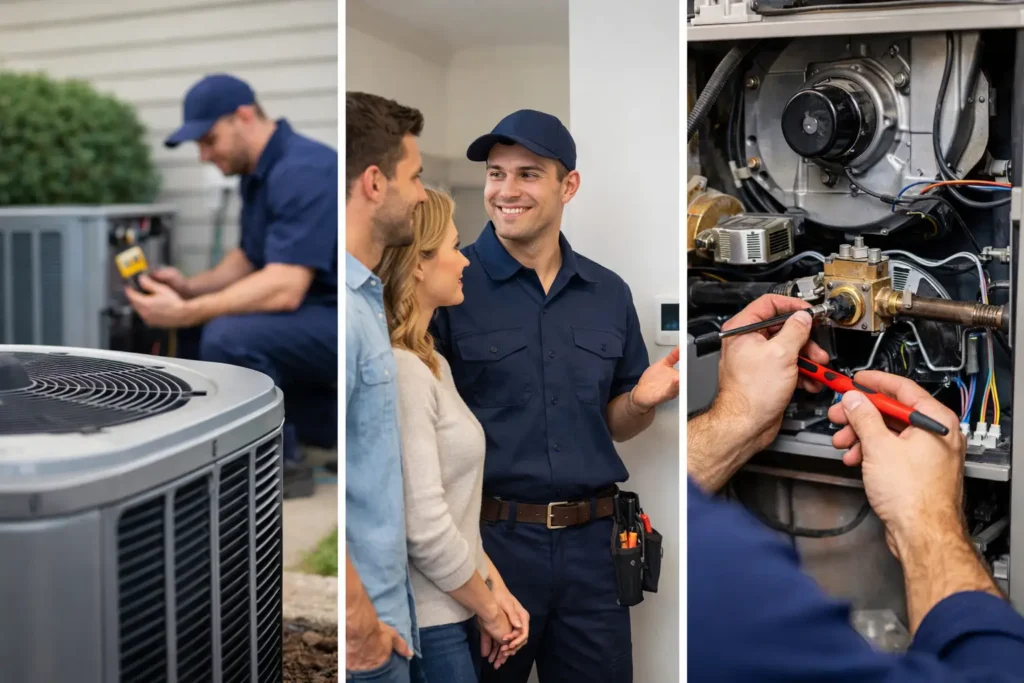
When your furnace quits on a cold Columbus morning or your AC starts blowing warm air during a sticky July afternoon, you usually do not need a lecture on HVAC theory. You need heating and cooling service that is fast, clear, and handled by people who can explain what is happening without making the problem harder than it already is.
That is where the quality of the service matters just as much as the repair itself. Homeowners are not just paying for a part replacement or a tune-up. They are paying for a process that removes guesswork, respects their time, and gives them a clear path forward.
What good heating and cooling service actually looks like
A lot of frustration starts before any tools come out. It starts with vague arrival windows, unclear pricing, or a technician who talks past the customer instead of to them. Good service feels organized from the first call. You know what kind of appointment you are booking, what the next step is, and when approval is needed before work begins.
For most households, that level of clarity matters because heating and cooling issues rarely show up at a convenient time. A furnace problem in winter can affect comfort fast. An AC issue in summer can make parts of the home unusable by afternoon. Even when the system is still running, strange noises, weak airflow, short cycling, or uneven temperatures create uncertainty. People want answers quickly, but they also want honest recommendations.
That is the balance a dependable heating and cooling service should provide. It should move quickly without rushing the diagnosis. It should explain the issue in plain language. And it should give options when options truly exist.
When to call for heating and cooling service
Some problems are obvious. If the system will not turn on, will not heat, or will not cool, it is time to schedule service. The same goes for burning smells, loud banging, water leaking around the unit, or air that feels far weaker than normal.
Other situations are less dramatic but still worth addressing early. A furnace that runs longer than usual, an AC that struggles on moderately hot days, or a thermostat that never seems to match the room temperature can point to a problem that gets more expensive if ignored. In many cases, early diagnostics are simpler than waiting until the system fully fails.
Age also matters, but not in a one-size-fits-all way. An older system is not automatically a system that needs replacement. Some units continue to perform well with proper maintenance and targeted repairs. Others become unreliable long before their expected lifespan because of installation issues, deferred maintenance, or repeated wear. The right call depends on performance, condition, repair history, and what the homeowner wants from the system over the next few years.
Repair or replacement depends on the full picture
This is where many customers feel pressure, and it is also where clear communication matters most. Not every repair should lead to a replacement conversation. At the same time, not every failing system should get one more repair just because it can.
A practical heating and cooling service should walk through the trade-offs. If the issue is isolated and the system is otherwise in good shape, a repair may be the best value. If breakdowns are becoming frequent, efficiency has dropped, and major components are wearing out, replacement may be the more stable long-term decision.
The key is transparency. Homeowners should understand what failed, what the repair addresses, and what it does not address. If a system can be repaired but is likely to need additional work soon, that should be stated clearly. If replacement is being discussed, the recommendation should be tied to the actual condition of the system, not a generic sales pitch.
Why pricing clarity matters in HVAC service
Heating and cooling problems create stress fast, especially when weather is extreme. That is exactly why pricing should not feel like a mystery. People need to know when they are paying for diagnosis, when they are reviewing repair options, and when approval is required before work starts.
Clear pricing does not mean giving final numbers without seeing the equipment. Real costs depend on the condition of the system, access, parts needed, and the exact repair or installation scope. But a professional service experience should still make the process understandable. Visible starting prices, flat-rate structure where applicable, and customer approval before work begins all help remove uncertainty.
That kind of structure is not just about convenience. It helps customers make better decisions. When the process is organized, people can focus on the recommendation instead of worrying about hidden charges or shifting expectations.
Heating and cooling service for older Columbus homes
In and around Columbus, many homes have quirks that affect heating and cooling performance. Older ductwork, room additions, uneven insulation, aging thermostats, and equipment installed years apart can all create comfort issues that are not solved by replacing one part and hoping for the best.
That is why a thorough diagnosis matters. A cold upstairs bedroom or a main floor that never cools evenly may not mean the whole system is failing. It could be an airflow issue, a control issue, a maintenance problem, or a mismatch between the equipment and the home layout. On the other hand, recurring comfort complaints across multiple seasons may point to a larger system concern.
The best service approach is practical. Fix what is actually wrong. Explain what is contributing to the problem. Give realistic options based on the home, the equipment, and the customer’s priorities.
What homeowners should expect during a service visit
A service appointment should feel straightforward. The technician should start by listening to what the homeowner has noticed – whether that is a noise, loss of airflow, inconsistent temperatures, or a total shutdown. From there, the system should be evaluated based on the symptoms and the equipment present.
Once the issue is identified, the next step should be simple explanation. What failed? What are the available solutions? Is this an immediate repair, a maintenance issue, or a sign of broader system decline? Customers should have the chance to approve work before anything moves forward.
This matters just as much for routine calls as emergency ones. Even when the fix is relatively small, people want confidence that the recommendation is grounded in what the system actually needs.
For many homeowners, speed is a major part of that experience. Same-day availability can make a difficult day much easier, especially during weather extremes. Still, it is reasonable for timing to depend on scheduling, access, technician availability, and the actual condition of the job. Fast response is valuable, but good work still requires proper diagnosis and customer approval.
Maintenance is not just about preventing breakdowns
Routine service gets framed as a way to avoid surprise repairs, and that is true, but it is not the whole story. Maintenance also helps systems run more consistently, catches wear before it becomes urgent, and gives homeowners a better sense of what to expect in the coming season.
That can be especially useful if your equipment is older but still operating. A maintenance visit may reveal that the system is handling well for now, or it may show patterns of wear that make budgeting for future work easier. Either way, the homeowner gets information before the situation becomes urgent.
There is also a comfort side to maintenance that people often overlook. Dirty filters, blocked drains, worn components, and neglected coils do not always shut a system down immediately. Sometimes they just make the house less comfortable, the airflow weaker, or the runtime longer. Small issues can quietly chip away at performance long before they become an emergency.
Choosing a company you can work with long term
Most people are not looking for a heating and cooling company they need once. They want a company they can call again without starting over. That means the experience should be dependable, not just the repair.
Look for service that is organized, clear about next steps, and respectful of the customer’s approval. Recommendations should feel practical, not inflated. Communication should be direct. The home should be treated professionally. And if follow-up is needed, it should not feel like you are chasing answers.
For homeowners in Columbus, that local consistency matters. Weather changes quickly here, and heating and cooling systems work hard across the year. Having a service team that understands the urgency, explains options clearly, and keeps the process simple can make a stressful problem feel much more manageable.
Transit & Flow approaches heating and cooling service with that mindset – clear communication, flat-rate pricing structure where applicable, visible starting prices, and practical recommendations based on what the home actually needs.
If your system is acting up, the best next step is usually not to wait for a complete breakdown. A clear diagnosis today can give you better options than an emergency tomorrow.
Need cooling you can count on? Browse our full air conditioning service Columbus menu and schedule service online in minutes.
